
New case from the Second Circuit Court of Appeals. Will review and comment later, but the opinion in the case of Royal & Sun Alliance Ins. v. Ocean World Lines, 2010 U.S. App. LEXIS 14825 and can be found here.

Recent COGSA Case from Sixth Circuit – Fortis Corporate Ins. v. Viken Ship Mgmt.
Recent COGSA case from the Sixth Circuit Court of Appeals. The case is Fortis Corporate Ins. v. Viken Ship Mgmt., which can be found here.
First off: the opinion was written by retired Justice Sandra Day O'connor (sheesh, so much for retirement being golf and grandkids).
Facts: during the transport of steel coils from Poland to Ohio, seawater intruded on the cargo hold and caused rust damage. The insurance company paid on the claim then brought a subrogration claim against the vessel owner and the ship's manager (who provided the Master, officers and crew).
Issue: The ship's manager brought a motion for summary judgment to dismiss the suit because it had been filed beyond the one-year statute of limitation in the Carriage of Goods at Sea Act (COGSA).
The ship's manager was trying to say that it was practically a "carrier" under COGSA and if it were a "carrier," then the lawsuit was time-barred.
Analysis: Justice O'connor rejected the "practical" test and found that COGSA was clear in its definition of carriers and ship's managers were not included in that definition. As such, simple negligence claims against non-carrier parties were valid. Justice O'connor noted that the parties were free to contractually expand the COGSA coverages, by way of a Himalaya clause in the bill of lading:
It is important to note that shipping parties are free to extend COGSA’s coverage by adding provisions to bills of lading extending the COGSA regime to any and all agents or independent contractors who participate in the shipment of goods under a particular contract. See Norfolk S. Ry. Co. v. Kirby, 543 U.S. 14, 30–31 (2004). These contractual provisions are known as “Himalaya clauses.” See generally, Marie Healey, Carriage of Goods by Sea: Application of the Himalaya Clause to Subdelegees of the Carrier, 2 Mar. Law 91 (1977). If the parties in this case wanted SM to be covered by COGSA’s terms, they could have provided for that contractually, but they chose not to do so. This is especially telling when the parties were contracting against the backdrop of nearly-uniform case law refusing to extend COGSA’s liabilities and immunities to ship managers absent such a Himalaya clause. The value of maintaining uniformity with our sister circuits is at a premium in cases involving the interpretation of maritime contracts, especially when the parties can easily alter the terms of their contracts to react to prevailing case law. Cf. Kirby, 543 U.S. at 28 (stressing need for uniformity in maritime law).
I feel the Need, the Need for Speed…
Stay tuned. We have an amazing, once-in-a-lifetime opportunity to visit the RONALD REAGAN during RIMPAC 2010, courtesy of Navy Region Hawaii.
New Maritime 4th Amendment Case from Eleventh Circuit – USA v. Zarabozo
New case from the Eleventh Circuit Court of Appeals which deals with Fourth Amendment protections on vessels. The case is United States of America v. Guillermo Alfonzo Zarabozo and the original opinion can be found here.
The facts are skimpy but it appears that the defendant was a migrant smuggler rescued from a life raft. Without a warrant, law enforcement searched a backpack in the liferaft. The smuggler challenged the warrantless search.
The Eleventh Circuit said, We conclude the district court did not err in finding these facts constituted exigent circumstances supporting the FBI agent’s warrantless search of Zarabozo’s bags. Zarabozo’s bags had been exposed to massive amounts of sea water, and the district court found law enforcement had a reasonable fear that any electronic or paper evidence might be irrevocably damaged if left in that condition.
Accordingly, the district court ruled it was reasonable for agents to search Zarabozo’s bags to collect evidence in danger of immediate deterioration. We conclude the court, therefore, committed no error in admitting into evidence the items found pursuant to that search.
Mahalo to Admiral and Mrs. Smith and the Navy Region Hawaii Barge Crew
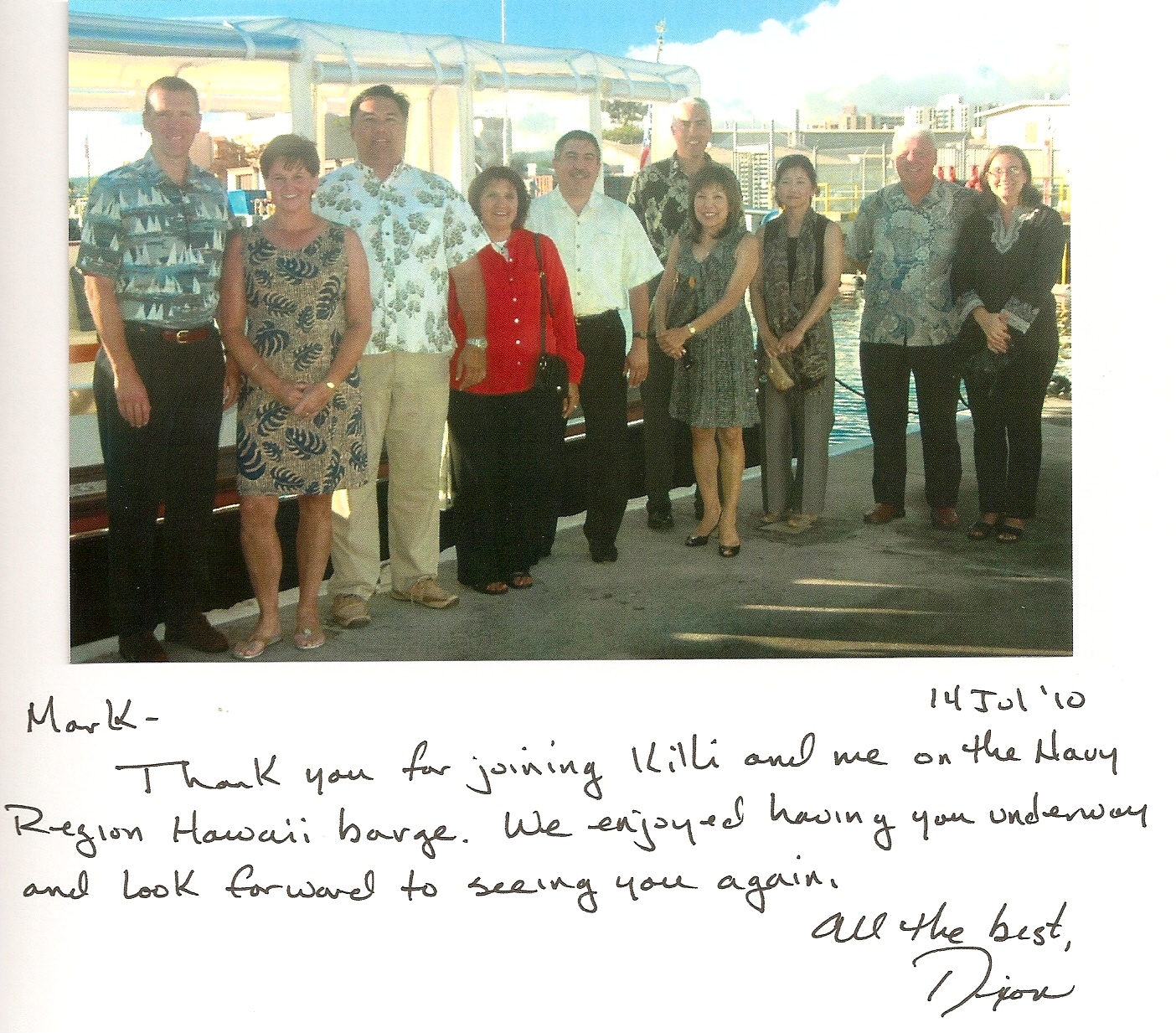
Sunset Tour of Pearl Harbor, Courtesy of U.S. Navy
I was privileged to be the guest of Rear Admiral Dixon Smith, U.S. Navy, during a sunset tour of Pearl Harbor tonight. Sorry Robert, no grog served onboard!
Admiral Smith, a surface warfare specialist, is the Commander of Navy Region Hawaii. Admiral Smith’s biography reflects a lifetime spent at sea in peace and war:
His
New Case from Fifth Circuit – Crescent Towing & Salvage Co. v. Chios Beauty Mv.
Hurricane Katrina, vessel collisions and letters of undertaking. All the makings of a great case!
This is a new admiralty case from the Fifth Circuit Court of Appeals. The case is Crescent Towing & Salvage Co. v. Chios Beauty Mv., 2010 U.S. App. LEXIS 13963 and the original decision can be found here.
Facts are brief: The master of the CHIOS BEAUTY decided to moor in New Orleans, just ahead of the landing of Hurricane Katrina. The vessel’s mooring lines parted in the storm and caused damage to a neighboring vessel. That vessel’s owners brought suit against the CHIOS BEAUTY in remand against the pilot of the vessel the owners of the CHIOS BEAUTY obtained a Letter of Undertaking that allowed for the release of the arrested CHIOS BEAUTY.
Issues: should a deferential, extremis standard of care govern the decision to moor in New Orleans just ahead of the hurricane (Translation: should the law expect masters to make the right decision during extreme events). Second, did the language of the Letter of Undertaking constitute a waiver of post-judgment interest?
STANDARD OF CARE IN EXTREMIS
The court set forth the principles behind the standard of care in extreme situations:
“It has long been the law that errors in judgment committed by a vessel put in sudden peril through no fault of her own are to be leniently judged. . . .Courts are not supposed to second guess parties in peril and expect from them the most precise judgments.” Union Oil Co. of Cal. v. Tug Mary Malloy, 414 F.2d 669, 674 (5th Cir. 1969). “[W]here, without prior negligence, a vessel is put in the very center of destructive natural forces and a hard choice between competing courses must immediately be made, the law requires that there be something more than mere mistake of judgment by the master in that decision in extremis.” Employers Ins. of Wausau v. Suwannee River SPA Lines, Inc., 866 F.2d 752, 771 (5th Cir. 1989) (quoting Boudoin v. J. Ray McDermott & Co., 281 F.2d 81, 84 (5th Cir. 1960)). However, the in extremis standard of care should not be applied to the actions of a captain who had ample time to avoid the peril. See Boudoin, 281 F.2d at 84-86 (in extremis standard does not apply to captain who
had time to choose a safer berth before hurricane struck).The court found that under the circumstances, the master of the CHIOS BEAUTY had other options and could have sailed to a safer port, in light of the weather information he had access to.
LETTERS OF UNDERTAKING
Letters of Undertaking are akin to a surety bond that will secure a claimant’s lawsuit and allow a vessel that has been arrested to be released.
In disputes over the interpretation of such letters, the court said:
Considering how common letters of undertaking are in the vessel seizure context, there are surprisingly few cases interpreting them. The few that do apply standard contract principles and specifically enforce their provisions.
See, e.g., Chiquita Int’l Ltd. v. Liverpool & London Steamship Prot. & Indem. Ass’n Ltd., 124 F. Supp. 2d 158 (S.D.N.Y. 2000).
The Letter in this case said:
This letter provided that the American Owners Mutual Protection and Indemnity Association, Inc. (“the Association”) undertook to pay Plaintiffs any sum . . . which either may be agreed between the parties and approved by the Association, or which is adjudged to be due . . . in the matter pending in the . . . District Court . . . from the Vessel, in rem, and/or its Owner by final judgment . . . provided that the total of our liability hereunder shall not exceed the sum of US$3,750,000.00 . . . inclusive of interest and costs.
At issue was whether the letter included post-judgment interest (and therefore would deny such recovery if it exceeded the letter amount), or whether it would provide payment in the amount specified PLUS post-judgment interest. The court found that it was the latter.
New Admiralty Case from Fifth Circuit – Osprey Ship Mgmt. v. Foster
New case from the Fifth Circuit Court of Appeals. The case is Osprey Ship Mgmt. v. Foster, 2010 U.S. App. LEXIS 135410, can the original opinion can be found here.
Facts: Ship being navigated by a Pilot allides with a submerged structure, outside of the navigable channel which was marked by a privately maintained buoy. At trial, the owner argued that the United States is liable for the allision because of a nautical chart error. The owner also sought liability against the pilot association. The Pilot and Captain are found equally negligent for the allision.
Appeal: On appeal, the Fifth Circuit resoundingly rejects the claim against the United States, criticizing the vessel’s owner’s “disingenuous, if not misleading” citation to a government manual. Typically, governmental discretionary acts which result in damages cannot be sued upon. The “discretionary function” immunizes such government action from litigation.
Second, the vessel owner challenged, then conceded, the liability of the pilot’s association.
On the Pilot’s appeal from the adverse decision, Pilot argued that the trial court made several erroneous findings of fact. The appeals court began by stating that Pilots are held to an “unusually high standard of care.” Citing this high standard of care, the appeals court affirmed the trial court’s finding that the Pilot did not exercise the standard of care in navigating the vessel:
Even if it were true that it was common knowledge that staying west of Red Buoy 2
would keep a vessel west of LW1, the district court was not clearly erroneous in
finding that Pilot Foster nevertheless understood that floating navigational aids
should not be relied upon to the exclusion of other navigational aids because they
can float or move at any time, and in finding that given his knowledge of the
river and of the location of LW1 (which his father, a local pilot, had hit with a
vessel previously) it was negligent to bring the vessel out of the improved
channel and so close to Red Buoy 2.Citing to his dad’s collision with the same buoy at issue in this case? Ouch.
The final point on appeal was that the Pilot and Captain should not be liable because the submerged structure (that was hit) was longer than its permit allowed. The trial court and appeals court found that the cause of this allision was not the length of the structure but the navigation of the vessel outside the marked channel.
New Ninth Circuit Case – NIED & Zone of Danger Under Maritime Law -Stacy v. Danielsen
This case takes us back to the first year of law school. (I didn’t go to a silk purse school, so we’ll add clerking for Justice Scalia to the jobs I won’t have).
Under maritime law, do near-miss accidents give rise to a claim of negligent infliction of emotional distress (NIED)? A new case from the Ninth Circuit Court of Appeals says: Yes, they do. The case is Stacy v. Danielsen, 2010 U.S. App. LEXIS 13222 and the court’s original opinion can be found here.
The facts are straightforward. Plaintiff was on a fishing boat near San Francisco in dense fog. The boat he was on has a near miss with a freighter which subsequently collides with a different fishing vessel. Unbeknownst to the Plaintiff, a person onboard the other fishing vessel was killed. Several days later, Plaintiff discovers of the death and suffers emotional distress as a result.
Plaintiff brings suit for NIED. On a defense motion to dismiss the suit for failure to state a claim, the trial court finds that because Plaintiff was not in the “zone of danger” when he suffered his psychic injury (to wit: emotional distress), he could not recover under a NIED theory.
A divided Ninth Circuit reversed that decision and found that:
Under this test, applicable in the maritime jurisdiction of the United States, a tort is committed by a defendant subjecting a plaintiff to emotional harm within “the zone of danger” created by the conduct of the defendant. Id. In Gottshall, the Supreme Court held that “the zone of danger” test allowed recovery for “those plaintiffs who sustain a physical impact as a result of a defendant’s negligent conduct, or who are placed in immediate risk of physical harm by that conduct.” Id. The Supreme Court went on to quote a law review article’s exposition:“That is, ‘those within the zone of danger of physical impact can recover for fright, and those outside of it cannot.’” Id. at 548 (quoting Richard N. Pearson, Liability to Bystanders for Negligently Inflicted Emotional Harm, 34 U. Fla. L. Rev. 447, 489 (1982)).
Finding that the Plaintiff had alleged that he was in the zone of danger and that he suffered emotional distress as a result, the majority found that he did state a claim that was cognizable under general maritime law and reversed the trial court’s dismissal of his claim.
The dissenting judge disagreed finding that as a matter of law, the Plaintiff was not in the zone of danger (he didn’t see or hear the collision, nor did he see or hear the fatality), ergo he failed to state a claim and his suit was properly dismissed.
I think a petition for rehearing en banc or a cert petition is likely on this one.
SCOTUS FOIA Case – Cert Petition Available
Yesterday, I posted about the Supreme Court taking a FOIA case from the Ninth Circuit, here. I have received the Petition for Certiorari from counsel and it is available here.
Mr. Milner requested an EQSD map for the Naval Magazine at Indian Island. The EQSD is a map which shows the blast radius for explosives and shows how far an explosion will “expand” should one of the munitions detonate.
At issue is an exemption from the Freedom of Information Act which protects from disclosure documents relating to internal personnel rules and practices of an agency.
5 U.S.C. § 552(b) of the Freedom of Information Act (“Exemption 2”) provides in pertinent part:
(b) This section [providing for public access to government documents] does not apply to matters that are:
(2) related solely to the internal personnel rules and practices of an agency.
Courts have created two categories of documents using this exemption: “High 2” and “Low 2”. The Supreme Court upheld the use of this exemption for documents that were trivial in nature. Dep’t of the Air Force v. Rose, 425 U.S. 352 (1976). The Ninth Circuit (and other courts of appeal) have created a “High 2” exemption for FOIA that allows documents that could circumvent an “agency regulation” to be withheld.
This petition seeks to undo the High 2 exemption from FOIA.
This will be very interesting in terms of the balance between national security and transparent democratic government. We shall also see the balancing of a textual approach to statutory interpretation and national security interests of the nation.