Exxon Valdez litigation update:

The Ninth Circuit Court of Appeals, on remand following the Supreme Court’s decision limited punitive damages to 1-1 ratio with compensatory damages, awarded post-judgment interest to the Plaintiffs in the amount of $507.5 million. Decision posted here.

But, per SCOTUSBLOG, Exxon has sought rehearing en banc, with regards to

Per the Blog of Legal Times, Justice Breyer appeared sheepish at the the arcane-ness of today's opinion on the tonnage clause of the U.S. Constitution (here).

Per BLT:

At the end, Breyer told the audience, "You know now more about the tonnage clause than many."

Another observation – it appears as if the Justices are more comfortable disclosing their original research, not relying merely on the litigants' briefs.  This was an interesting cite:

We can find little, if any, other personal property that it taxes. According to the State of Alaska, Valdez specifically exempts from property taxation motor vehicles, aircraft, and other vehicles, as well as business machinery. See Dept. of Community and Economic Development, Division of Community and Business Development, Office of the State Assessor, Alaska Taxable 2001, p. 20 (Jan. 2002), (Table 4), online at http://www.commerce.state.ak.us/dca/Taxable/AKTaxable2001.pdf (as visited June 10, 2009, and available in Clerk of Court’s case file).

As visited June 10, 2009? 

This reminds me of the hubbub last year when a broad statement in a death penalty case was disputed in a military law blog (CAAFlogpost.  The Supreme Court's decision didn't change, but it appears as if the Court is not going to rely solely on the briefs to provide the applicable law.  Great post on social media and the Supreme Court here.

My earlier post on Polar Tankers case, including links to briefs and transcripts,  here.

Proponents of the Hawaii Invasive Species Assessment should monitor recent developments in tonnage and commerce clause litigation.  The Second Circuit Court of Appeals recently struck down a fee on passengers using an interstate ferry.  It cited the commerce and tonnage clauses as the basis for striking down the local regulation.

Side note:  Thanks to my

The Court of Appeals for the Ninth Circuit just issued its opinion in the case of Mazda Motors of America, Inc. v. M/V Cougar Ace (opinion here).

The legal issue is whether a defendant in rem can assert a contract right despite being a non-party to the contract.  The clause in question was a forum selection clause.

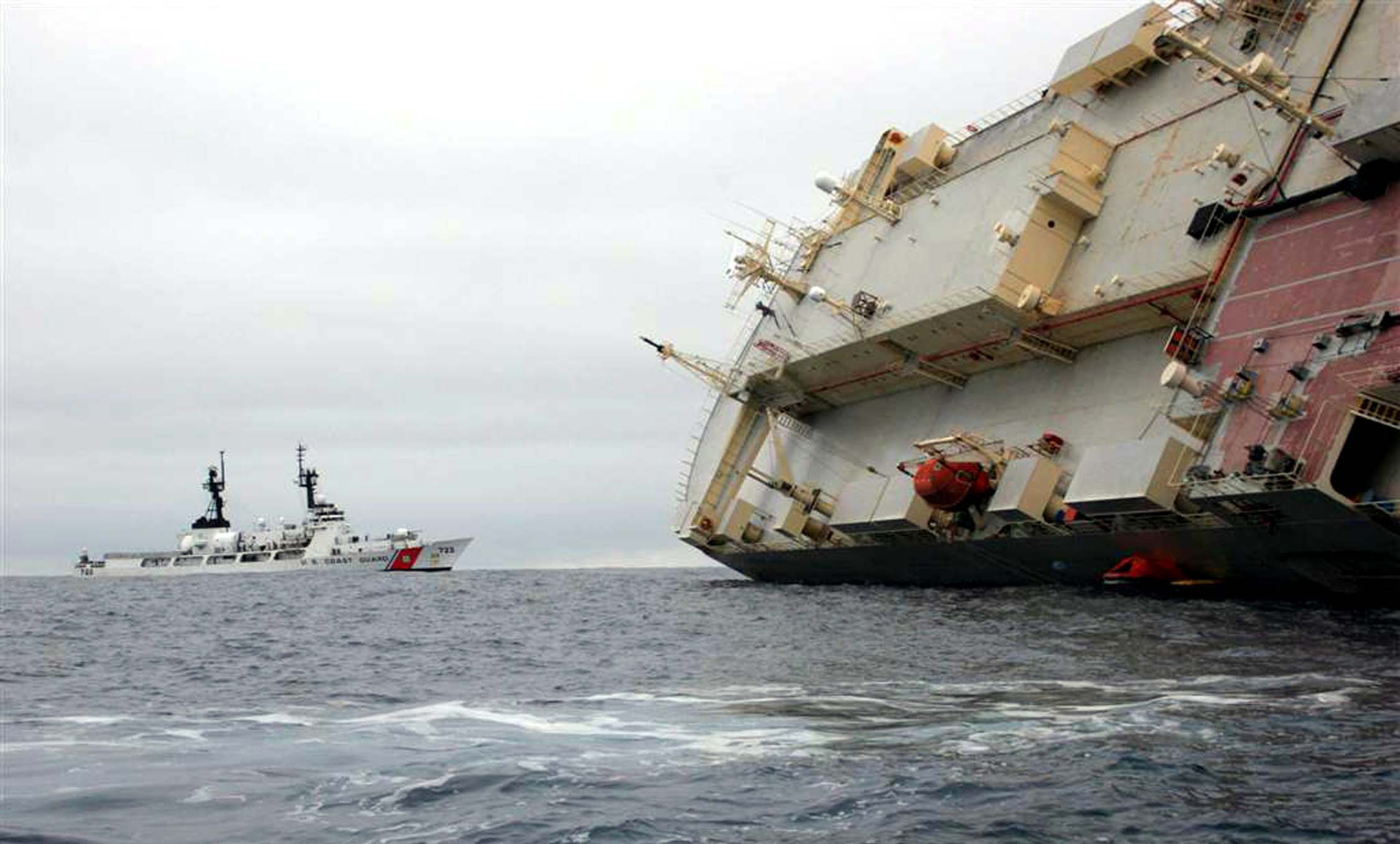
This case arises out of the M/V Cougar Ace mishap (depicted here)

Cougarace 

The bills of lading for the cargo had a forum selection clause requiring that disputes be resolved in Tokyo, Japan.  The ship itself was not a party to the bills of lading, but was named as a defendant in a proceeding brought in Portland, Oregon.  The bills of lading had a Himalaya clause which provided:

The Merchant undertakes that no claim or allegation shall be made against any servant, agent or Sub- Contractor of the Carrier which imposes or attempts to impose upon any of them, or upon any vessel owned or operated by any of them, any liability whatsoever in connection with the Goods, and, if any such claim or allegation should nevertheless be made, to indemnify the Carrier against all consequences thereof. Without prejudice to the foregoing, every such servant, agent and Sub-Contractor shall have the benefit of all provisions herein benefiting
the Carrier as if such provisions were expressly for their benefit; and in entering into this contract, the Carrier, to the extent of those provisions, does so not only on its own behalf, but also as agent and trustee for such servants, agents and Sub-Contractors.

The Himalaya clause contractually allows non-parties to assert rights under the contract.  The Ninth Circuit’s opinion seemed compelled by the Supreme Court’s 2004 decision in the Norfolk Southern Railway Co. v. Kirby decision.  The unanimous decision required an expansive view of Himalaya clauses (which theretofore had been construed narrowly).  Justice O’Connor stated:

The Court of Appeals’ ruling is not true to the contract language or to the intent of the parties. The plain language of the Himalaya Clause indicates an intent to extend the liability limitation broadly — to “any servant, agent or other person (including any independent contractor)” whose services contribute to performing the contract. App. to Pet. for Cert. 59a, cl. 10.1 (emphasis added). “Read naturally, the word `any’ has an expansive meaning, that is, `one or some indiscriminately of whatever kind.’” United States v. Gonzales, 520 U. S. 1, 5 (1997) (quoting Webster’s Third New International Dictionary 97 (1976)). There is no reason to contravene the clause’s obvious meaning. See Green v. Biddle, 8 Wheat. 1, 89-90 (1823) (“[W]here the words of a law, treaty, or contract, have a plain and obvious meaning, all construction, in hostility with such meaning, is excluded”). The expansive contract language corresponds to the fact that various modes of transportation would be involved in performing the contract. Kirby and ICC contracted for the transportation of machinery from Australia to Huntsville, Alabama, and, as the crow flies, Huntsville is some 366 miles inland from the port of discharge. See G. Fitzpatrick & M. Modlin, Direct-Line Distances 168 (1986). Thus, the parties must have anticipated that a land carrier’s services would be necessary for the contract’s performance. It is clear to us that a railroad like Norfolk was an intended beneficiary of the ICC bill’s broadly written Himalaya Clause. Accordingly, Norfolk’s liability is limited by the terms of that clause.

Apparently, there had never been a reported decision of an in rem defendant being protected by the Himalaya clause…till today. 

Yesterday, the Supreme Court heard oral arguments in the Polar Tankers v. City of Valdez case.  The transcript is here.

In my earlier post, I suggested that the Court took the case not on the duty of tonnage issue but rather on discriminatory interstate tax schemes (think internet sales tax).  The amici briefs were virtually all in this camp.

Oral arguments, however, were ALL about the tonnage clause of the Constitution.  It suggests to me that the Court was NOT ready to wade into the interstate tax issue and the tonnage issue was a very, very clean way to strike down the tax, without creating precedent that would apply to the several states’ ability to tax internet sales, etc. 

One great moment in the transcript which confronts, perhaps, a shortcoming of the Original Intent doctrine.  In short (and admittedly superficial) fashion, this doctrine or judicial philosophy calls for the interpretation of the Constitution, at the time it was drafted.  So, to define terms like “cruel and unusual” or “arms,” Originalists will turn to the 1700’s for clues as to meaning. 

So, does the tonnage clause include air or rail, invented long after the drafting of the Constitution?

CHIEF JUSTICE ROBERTS:  Well, but just on a — maybe this doesn’t matter. I have seen the capacity of cargo planes described in terms of tonnage. Does this clause apply to those?

MR. ROTHFELD: That — that is an interesting question. It — it was written to apply to ships simply because in the late 18th century, the only way of moving substantial amounts of cargo was by — was by vessel. And I imagine that if the Framers had in mind airplanes and railroads –

CHIEF JUSTICE ROBERTS: It is that we have an evolving Constitution, after all.

MR. ROTHFELD: I will leave that one alone, Your Honor.

(Laughter.)

CHIEF JUSTICE ROBERTS: Well, then, do you know — it’s not an entirely frivolous point. I mean, do you know if States, localities where airports are located charge things that might be viewed as Tonnage Clauses on airplanes?

MR. ROTHFELD: I don’t know a definitive answer to that. ..

Side note: As posted here, Hawaii’s invasive species assessement fee does impose a tax on cargo, both on vessels and airplanes.  A per ton fee is tough to calculate on a parcel carried on an airplane for sure.

Background Materials on the case:

My posts: herehere.

The question presented is:

1. Whether a municipal personal property tax that falls exclusively on large vessels using the municipality’s harbor violates the Tonnage Clause of the Constitution, art. I, § 10, cl. 3.

2. Whether a municipal personal property tax that is apportioned to reach the value of property with an out-of-State domicile for periods when the property is on the high seas or otherwise outside the taxing jurisdiction of any State violates the Commerce and Due Process Clauses of the Constitution.

Polar Tankers Opening Brief is here.

City of Valdez Answering Brief is here.

Amici:  Broadband Tax Institute (brief here)(supporting the out-of-state tax argument); the Council on State Taxation (brief here)(out-of-state tax argument); Tropical Shipping and Construction Company, Ltd. (brief here)(tonnage argument); World Shipping Council and Cruise Lines International Assn. (brief here)(tonnage argument); the National Federation of Independent Business Small Business Legal Center (brief here)(out-of-state tax argument); Seventeen State Governments (brief here)(supporting Valdez); and the Multistate Tax Commission (brief here)(supporting Valdez). 

Polar Tankers Reply Brief here.