2009

Per the Blog of Legal Times, Justice Breyer appeared sheepish at the the arcane-ness of today's opinion on the tonnage clause of the U.S. Constitution (here).

Per BLT:

At the end, Breyer told the audience, "You know now more about the tonnage clause than many."

Another observation – it appears as if the Justices are more comfortable disclosing their original research, not relying merely on the litigants' briefs.  This was an interesting cite:

We can find little, if any, other personal property that it taxes. According to the State of Alaska, Valdez specifically exempts from property taxation motor vehicles, aircraft, and other vehicles, as well as business machinery. See Dept. of Community and Economic Development, Division of Community and Business Development, Office of the State Assessor, Alaska Taxable 2001, p. 20 (Jan. 2002), (Table 4), online at http://www.commerce.state.ak.us/dca/Taxable/AKTaxable2001.pdf (as visited June 10, 2009, and available in Clerk of Court’s case file).

As visited June 10, 2009? 

This reminds me of the hubbub last year when a broad statement in a death penalty case was disputed in a military law blog (CAAFlogpost.  The Supreme Court's decision didn't change, but it appears as if the Court is not going to rely solely on the briefs to provide the applicable law.  Great post on social media and the Supreme Court here.

My earlier post on Polar Tankers case, including links to briefs and transcripts,  here.

Will wonders never cease.  The Navy signed on to assist the Coast Guard monitor marine resources in the Central and Western Pacific.  To that end, Coast Guard shipriders are deploying on the USS Crommelin today.

While such deployments are routine for counterdrug operations in the Caribbean and Eastern Pacific, and embargo operations in the Persian Gulf, Navy ship involvement in fisheries enforcement is more rare [author's note – I have been in the Coast Guard or Reserve since 1988 and I've never heard of it]. 

Such cooperation is important as the world's fisheries resources become more scarce.  Additionally, the United States has several island "possessions" throughout the Pacific Ocean that, the United States asserts, entitles the United States to Exclusive Economic Zones.  These zones are too vast for Coast Guard ships and aircraft to patrol often, so Navy involvement is helpful. And, the Coast Guard shipriders alleviate any posse comitatus concerns. 

Per the Coast Guard press release:

"This mission will increase the awareness of the maritime domain and further enhance the Coast Guard's interoperability with the Navy as well as law enforcement assets from our regional partners," said Cmdr. Mark Young, chief of enforcement for the Fourteenth Coast Guard District here.

Foreign vessel incursions into these zones, to harvest fish, occurs.  In fact, the owner of a Marshall Islands flagged fishing vessel just agreed to a $500,000 fine for illegal fishing near Howland and Baker islands.

Per the Coast Guard press release:

The owner of the Marshalls 201, a Republic of the Marshall Islands-flagged "purse seine" fishing vessel, has agreed to pay the penalty for violating the Magnuson-Stevens Fishery Conservation and Management Act for fishing illegally in the Exclusive Economic Zone (EEZ) of the United States adjacent to Howland and Baker Islands.  

The case began Sept. 9, 2006, when the Coast Guard and NOAA conducted a joint fisheries patrol of the remote EEZ adjacent to the U.S. National Wildlife Refuges at Howland and Baker. 

A Coast Guard air crew aboard a C-130 long-range search plane based at Air Station Barbers Point in

Honolulu,

sighted the crew of the

Marshalls

201 with the vessel’s fishing gear in the water approximately two miles inside the EEZ.  

The air crew immediately contacted the crew of the Honolulu-based 225-foot Coast Guard buoy tender Walnut, which changed course and intercepted the

Marshalls

201 with the intent to board the fishing vessel at sea. 

After a chase at sea for more than four hours, the master of the Marshalls 201 finally 'heaved to' or slowed down enough for the buoy tender to come alongside. Walnut’s crew boarded the

Marshalls

201 and confirmed that it had been fishing illegally in a U.S. EEZ.

Proponents of the Hawaii Invasive Species Assessment should monitor recent developments in tonnage and commerce clause litigation.  The Second Circuit Court of Appeals recently struck down a fee on passengers using an interstate ferry.  It cited the commerce and tonnage clauses as the basis for striking down the local regulation.

Side note:  Thanks to my

A former shipmate of mine asked me for my thoughts on the recourse an American company would have after a fleet of its boats were seized by a foreign government.  Per this Marinelog.com post, Venezuela has apparently seized/nationalized an American company’s vessel fleet in Lake Maracaibo. 

240px-Lake_Maracaibo_map 

My shipmate’s question is a very complicated one worthy of several books, cases and law reviews (many exist), but in the interest of brevity and overview, here goes:

The “nationalization” or expropriation of assets is not a new happening on the world stage.  From a legal perspective, a country’s seizure of property within its borders was not viewed upon as actionable under U.S. law.  See Banco Nacional de Cuba v. Sabatino, 376 U.S. 298 (1964)(adopting the act of state doctrine to exempt such seizures from review in U.S. courts).

In the wake of the Cuba expropriations and the Supreme Court’s Banco decision, Congress adopted federal law that superceded the decision.  This law, 22. U.S.C. 2370 provides:

(e) Nationalization, expropriation or seizure of property of United States citizens, or taxation or other exaction having same effect; failure to compensate or to provide relief from taxes, exactions, or conditions; report on full value of property by Foreign Claims Settlement Commission; act of state doctrine.
   (1) The President shall suspend assistance to the government of any country to which assistance is provided under this or any other Act when the government of such country or any government agency or subdivision within such country on or after January 1, 1962–
      (A) has nationalized or expropriated or seized ownership or control of property owned by any United States citizen or by any corporation, partnership or association not less than 50 per centum beneficially owned by United States citizens, or
      (B) has taken steps to repudiate or nullify existing contracts or agreements with any United States citizen or any corporation, partnership, or association not less than 50 per centum beneficially owned by United States citizens, or
      (C) has imposed or enforced discriminatory taxes or other exactions, or restrictive maintenance or operational conditions, or has taken other actions, which have the effect of nationalizing, expropriating, or otherwise seizing ownership or control of property so owned, and such country, government agency, or government subdivision fails within a reasonable time (not more than six months after such action, or, in the event of a referral to the Foreign Claims Settlement Commission of the United States within such period as provided herein, not more than twenty days after the report of the Commission is received) to take appropriate steps, which may include arbitration, to discharge its obligations under international law toward such citizen or entity, including speedy compensation for such property in convertible foreign exchange, equivalent to the full value thereof, as required by international law, or fails to take steps designed to provide relief from such taxes, exactions, or conditions, as the case may be; and such suspension shall continue until the President is satisfied that appropriate steps are being taken, and the provisions of this subsection shall not be waived with respect to any country unless the President determines and certifies that such a waiver is important to the national interests of the United States. Such certification shall be reported immediately to Congress.
   Upon request of the President (within seventy days after such action referred to in subparagraphs (A), (B), or (C) of paragraph (1)), the Foreign Claims Settlement Commission of the United States (established pursuant to Reorganization Plan No. 1 of 1954, 68 Stat. 1279 note]) is hereby authorized to evaluate expropriated property, determining the full value of any property nationalized, expropriated, or seized, or subjected to discriminatory or other actions as aforesaid, for purposes of this subsection and to render an advisory report to the President within ninety days after such request. Unless authorized by the President, the Commission shall not publish its advisory report except to the citizen or entity owning such property. There is hereby authorized to be appropriated such amount, to remain available until expended, as may be necessary from time to time to enable the Commission to carry out expeditiously its functions under this subsection.
   (2) Notwithstanding any other provision of law, no court in the United States shall decline on the ground of the federal act of state doctrine to make a determination on the merits giving effect to the principles of international law in a case in which a claim of title or other right to property is asserted by any party including a foreign state (or a party claiming through such state) based upon (or traced through) a confiscation or other taking after January 1, 1959, by an act of that state in violation of the principles of international law, including the principles of compensation and the other standards set out in this subsection: Provided, That this subparagraph shall not be applicable (1) in any case in which an act of a foreign state is not contrary to international law or with respect to a claim of title or other right to property acquired pursuant to an irrevocable letter of credit of not more than 180 days duration issued in good faith prior to the time of the confiscation or other taking, or (2) in any case with respect to which the President determines that application of the act of state doctrine is required in that particular case by the foreign policy interests of the United States and a suggestion to this effect is filed on his behalf in that case with the court.

The seizure may implicate U.S. law and give rise to claims against Venezuela if the expropriation was done in violation of international law.  United Nations General Assembly Resolution 1803 may provide such violation if the seizure was done without compensation.  If the owner is compensated, then it may not have recourse. 

One mechanism used for other cases of expropriation is the Foreign Claims Settlement Commission.  It appears that most of its cases are not run-of-the-mill claims but post-war, post-terrorist incident type matters.

Interesting issue to watch in these uncertain economic times.

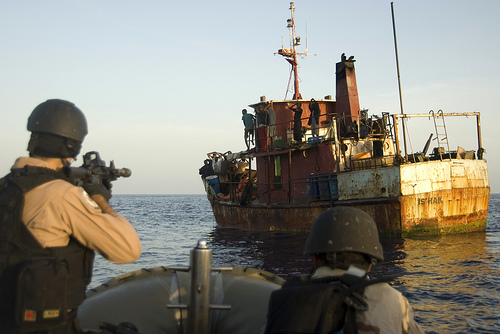
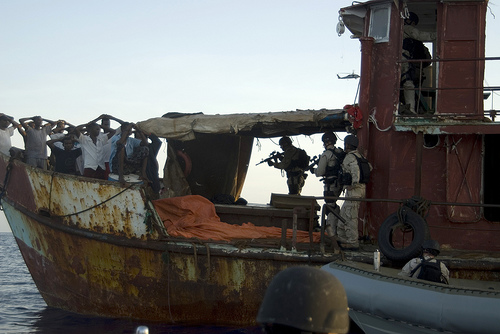
Last week, I posted an Op-Ed from Newsweek asserting that the Coast Guard was the better service to address Somali piracy (post here).  The “war” on drugs has required the use of Coast Guard Law Enforcement Detachments (LEDETs) embarked on Navy ships (typically, less capable frigates) to extend the reach of U.S. law enforcement without requiring the nation to build more Coast Guard cutters.  The model works well and has been employed in the Persian Gulf since the first Gulf War.  In fact, the first Coast Guardsman killed in combat since Vietnam, Petty Officer Nathan Bruckenthal, lost his life with two sailors while intervening in a suicide bomb attack on an Iraqi oil platform in 2004.

Per the Navy’s post on flickr.com:

GULF OF ADEN (May 13, 2009) Members of a visit, board, search and seizure (VBSS) team from the guided-missile cruiser USS Gettysburg (CG 64) and U.S. Coast Tactical Law Enforcement Team South Detachment 409 capture suspected pirates after responding to a merchant vessel distress signal while operating in the Combined Maritime Forces (CMF) area of responsibility as part of Combined Task Force (CTF) 151. CTF 151 is a multinational task force established to conduct counter-piracy operations under a mission-based mandate throughout the CMF area of responsibility to actively deter, disrupt and suppress piracy in order to protect global maritime security and secure freedom of navigation for the benefit of all nations. (U.S. Navy photo by Mass Communication Specialist 1st Class Eric L. Beauregard/Released) 
 
SomPiracy1 
 
SomPiracy