Well, no cert petition yet, but the Ninth Circuit rejected the Sea Shepherd Conservation Society's petition for rehearing en banc.  I earlier posted about this case here.Per the court:The opinion is amended as follows:Defendants-Appellees’ petition for rehearing en banc is denied. See Fed. R. App. P. 35.

Paul Watson’s petition for rehearing en

So, apparently I'm not the only person to get emails offering Canadian pharmaceuticals or random free stuff.  The federal government is not above the email ruse to bring an alleged pirate to justice.The Court of Appeals for the D.C. Circuit just handed down a decision upholding the prosecution of an alleged Somali pirate or pirate-helper.

On Tuesday, President Obama issued an Executive Order relating to the Somalia piracy situation.  The Executive Order took effect immediately.  It purports to “block” payments, transfers or donations of property to several classes of individuals related to the crisis in Somalia.

The text of the Executive Order, the concurrently released message to Congress and the Annex are provided below.  When reviewing the legality of such an Executive Order, the starting point is to identify the statutory authorization for such an action.  As President Truman found out during the Korean War, the Executive Branch of the federal government is constitutionally constrained by its inability to legislate and any actions which purport to legislate are unconstitutional.  See Steel Seizure Case.

In this case, as you would expect, the President does have wide authority in the realm of international financial transactions and national defense.  See 50 U.S.C. s. 1702.  The maritime community is abuzz about this E.O. (hat tip to the Maritime Law Association of the U.S. for sending me the attached documents). Stay tuned.

The E.O. states:

I, BARACK OBAMA, President of the United States of America, find that the deterioration of the security situation and the persistence of violence in Somalia, and acts of piracy and armed robbery at sea off the coast of Somalia, which have repeatedly been the subject of United Nations Security Council resolutions (including Resolution 1844 of November 20, 2008; Resolution 1846 of December 2, 2008; Resolution 1851 of December 16, 2008; and Resolution 1897 of November 30, 2009), and violations of the arms embargo imposed by the United Nations Security Council in Resolution 733 of January 23, 1992, and elaborated upon and amended by subsequent resolutions (including Resolution 1356 of June 19, 2001; Resolution 1725 of December 6, 2006; Resolution 1744 of February 20, 2007; Resolution 1772 of August 20, 2007; Resolution 1816 of June 2, 2008; and Resolution 1872 of May 26, 2009), constitute an unusual and extraordinary threat to the national security and foreign policy of the United States, and I hereby declare a national emergency to deal with that threat.

I hereby order:

Section 1. (a) All property and interests in property that are in the United States, that hereafter come within the United States, or that are or hereafter come within the possession or control of any United States person, including any overseas branch, of the following persons are blocked and may not be transferred, paid, exported, withdrawn, or otherwise dealt in:

(i) the persons listed in the Annex to this order;

and

(ii) any person determined by the Secretary of the Treasury, in consultation with the Secretary of State:

(A) to have engaged in acts that directly or indirectly threaten the peace, security, or stability of Somalia, including

but not limited to:

(1) acts that threaten the Djibouti Agreement of August 18, 2008, or the political process; or

(2) acts that threaten the Transitional Federal Institutions, the African Union Mission in Somalia (AMISOM), or other international peacekeeping operations related to Somalia;

(B) to have obstructed the delivery of humanitarian assistance to Somalia, or access to, or distribution of, humanitarian assistance in Somalia;

(C) to have directly or indirectly supplied, sold, or transferred to Somalia, or to have been the recipient in the territory of Somalia of, arms or any related materiel, or any technical advice, training, or assistance, including financing and financial assistance, related to military activities;

(D) to have materially assisted, sponsored, or provided financial, material, logistical, or technical support for, or goods or services in support of, the activities described in subsections (a)(ii)(A), (a)(ii)(B), or (a)(ii)(C) of this section or any person whose property and interests in property are blocked pursuant to this order; or

(E) to be owned or controlled by, or to have acted or purported to act for or on behalf of, directly or indirectly, any person whose property and interests in property are blocked pursuant to this order.

(b) I hereby determine that, among other threats to the peace, security, or stability of Somalia, acts of piracy or armed robbery at sea off the coast of Somalia threaten the peace, security, or stability of Somalia. (c) I hereby determine that, to the extent section 203(b)(2) of IEEPA (50 U.S.C. 1702(b)(2)) may apply, the making of donations of the type of articles specified in such section by, to, or for the benefit of any person whose property and interests in property are blocked pursuant to subsection (a) of this section would seriously impair my ability to deal with the national emergency declared in this order, and I hereby prohibit such donations as provided by subsection (a) of this section.

(d) The prohibitions in subsection (a) of this section include but are not limited to:

(i) the making of any contribution or provision of funds, goods, or services by, to, or for the benefit of any person whose property and interests in property are blocked pursuant to this order; and

(ii) the receipt of any contribution or provision of funds, goods, or services from any such person.

(e) The prohibitions in subsection (a) of this section apply except to the extent provided by statutes, or in regulations, orders, directives, or licenses that may be issued pursuant to this order, and notwithstanding any contract entered into or any license or permit granted prior to the effective date of this order.

Sec. 2. (a) Any transaction by a United States person or within the United States that evades or avoids, has the purpose of evading or avoiding, causes a violation of, or attempts to violate any of the prohibitions set forth in this order is prohibited.

(b) Any conspiracy formed to violate any of the prohibitions set forth in this order is prohibited.

Sec. 3. For the purposes of this order:

(a) the term “person” means an individual or entity;

(b) the term “entity” means a partnership, association, trust, joint venture, corporation, group, subgroup, or other organization;

(c) the term “United States person” means any United States citizen, permanent resident alien, entity organized under the laws of the United States or any jurisdiction within the United States (including foreign branches), or any person in the United States;

(d) the term “Transitional Federal Institutions” means the Transitional Federal Charter of the Somali Republic adopted in February 2004 and the Somali federal institutions established pursuant to such charter, and includes their agencies, instrumentalities, and controlled entities; and

(e) the term “African Union Mission in Somalia” means the mission authorized by the United Nations Security Council in Resolution 1744 of February 20, 2007, and reauthorized in subsequent resolutions, and includes its agencies, instrumentalities, and controlled entities.

Sec. 4. For those persons whose property and interests in property are blocked pursuant to this order who might have a constitutional presence in the United States, I find that because of the ability to transfer funds or other assets instantaneously, prior notice to such persons of measures to be taken pursuant to this order would render those measures ineffectual. I therefore determine that for these measures to be effective in addressing the national emergency declared in this order, there need be no prior notice of a listing or determination made pursuant to section 1(a) of this order.

Sec. 5. The Secretary of the Treasury, in consultation with the Secretary of State, is hereby authorized to take such actions, including the promulgation of rules and regulations, and to employ all powers granted to the President by IEEPA and the UNPA, as may be necessary to carry out the purposes of this order. The Secretary of the Treasury may redelegate any of these functions to other officers and agencies of the United States Government consistent with applicable law. All agencies of the United States Government are hereby directed to take all appropriate measures within their authority to carry out the provisions of this order.

Sec. 6. The Secretary of the Treasury, in consultation with the Secretary of State, is hereby authorized to submit the recurring and final reports to the Congress on the national emergency declared in this order, consistent with section 401(c) of the NEA (50 U.S.C. 1641(c)) and section 204(c) of IEEPA (50 U.S.C. 1703(c)).

Sec. 7. The Secretary of the Treasury, in consultation with the Secretary of State, is hereby authorized to determine that circumstances no longer warrant the blocking of the property and interests in property of a person listed in the Annex to this order, and to take necessary action to give effect to that determination.

Sec. 8. This order is not intended to, and does not, create any right or benefit, substantive or procedural, enforceable at law or in equity by any party against the United States, its departments, agencies, or entities, its officers, employees, or agents, or any other person.

Sec. 9. This order is effective at 12:01 a.m. eastern daylight time on April 13, 2010.

BARACK OBAMA

The White House issued a message to Congress re Somalia regarding this Executive Order and also published the Annex with the names of the individuals now “blocked.”

Captain Bryant has a great post on three recent Coast Guard Port Security Advisories related to defending U.S. flagged, commercial vessels from the threat of piracy.  The three advisories are available for download at his blog.

From the Coast Guard's advisory:

Working with our interagency partners we have identified at least three options under which firearms could be exported and used aboard vessels in compliance with the ITAR, 1) obtaining a temporary export license (DSP-73), 2) temporarily exporting firearms and ammunition under an exemption to the ITAR, and 3) purchasing foreign firearms and filing for a temporary import license (DSP-61) when entering U.S. ports. The option that provides the most flexibility for an owner or operator of a vessel would be to obtain a DSP-73 temporary export license in accordance with 22 CFR 123.5. (Please note that in order to apply for a DSP-73, you must first register with the Department of State. Information on registering is available below.) This license is valid for up to four years, may be used for multiple entries and exits, and would require the operator to identify and list on the license application the firearms or other defense articles (e.g., ammunition) to be carried aboard the vessel. Once the license is obtained the operator could then stow the firearms on board the vessel in a U.S. port and keep them stored aboard the vessel until needed for use within the High Risk Waters by the crew or contracted security teams. Prior to entering or exiting the United States the license holder or their authorized freight forwarder would present the DSP-73 to CBP officials as part of clearing customs. Prior to leaving the United States the license holder or their authorized freight forwarder would have to submit the Electronic Export Information (EEI) through the Automated Export System.

To be sure, this only applies to U.S. vessels carrying firearms when departing U.S. ports and there is a personal exemption detailed in the post. 

Last week, I posted an Op-Ed from Newsweek asserting that the Coast Guard was the better service to address Somali piracy (post here).  The “war” on drugs has required the use of Coast Guard Law Enforcement Detachments (LEDETs) embarked on Navy ships (typically, less capable frigates) to extend the reach of U.S. law enforcement without requiring the nation to build more Coast Guard cutters.  The model works well and has been employed in the Persian Gulf since the first Gulf War.  In fact, the first Coast Guardsman killed in combat since Vietnam, Petty Officer Nathan Bruckenthal, lost his life with two sailors while intervening in a suicide bomb attack on an Iraqi oil platform in 2004.

Per the Navy’s post on flickr.com:

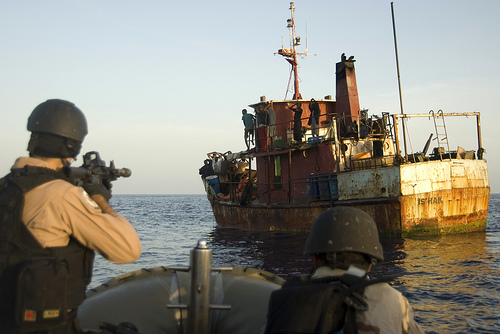
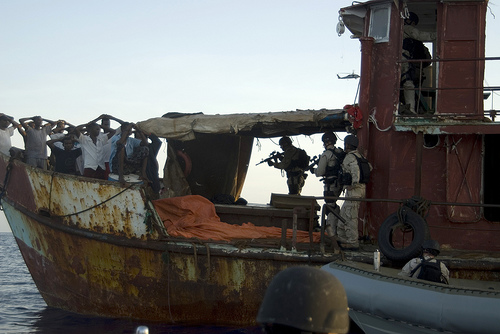
GULF OF ADEN (May 13, 2009) Members of a visit, board, search and seizure (VBSS) team from the guided-missile cruiser USS Gettysburg (CG 64) and U.S. Coast Tactical Law Enforcement Team South Detachment 409 capture suspected pirates after responding to a merchant vessel distress signal while operating in the Combined Maritime Forces (CMF) area of responsibility as part of Combined Task Force (CTF) 151. CTF 151 is a multinational task force established to conduct counter-piracy operations under a mission-based mandate throughout the CMF area of responsibility to actively deter, disrupt and suppress piracy in order to protect global maritime security and secure freedom of navigation for the benefit of all nations. (U.S. Navy photo by Mass Communication Specialist 1st Class Eric L. Beauregard/Released) 
 
SomPiracy1 
 
SomPiracy

Found this interesting article in Newsweek which suggests that the U.S. Coast Guard and not the Navy is better suited to address the Somali piracy situation.

The counterpiracy plan outlined Wednesday by Secretary of State Hillary Clinton was short on specifics, but long on nuance. Clinton committed to tracking and freezing the Somali bandits' finances—something that could prove difficult—while also working with shipping conglomerates and insurance companies to address "gaps in their self-defense measures." With a heavy military presence in the region all but off the table, given officials' remarks on the subject, what could that mean?

John Patch, a retired Navy commander who now teaches at the U.S. Army War College, has one possible answer. In the past few months, Patch has repeatedly said the global security threat posed by pirates is "overstated." But if Washington now feels compelled to respond to the surge in piracy in the Gulf of Aden, Patch argues, the best approach would be to treat the problem as a law-enforcement issue, not a military mission. NEWSWEEK's Katie Paul spoke to him about why, if the U.S. is to play any armed role in responding to the Somali pirates, the Coast Guard might be its best bet.

While the Coast Guard is likely the best maritime military force worldwide to address Somali piracy, bar none, it is plainly too small to take on another mission.  Law Enforcement Detachment (LEDETs) embarked on Navy or other allied ships could provide a crucial, internationally viable response to the pirate threat.  Endgame remains a vexing issue and absent political will for prosecution/incarceration in other countries, the Gulf of Aden's cat and mouse game will continue.