
News Flash – the Supreme Court issued a decision in Pacific Operations Offshore, LLP v. Valladolid, an Outer Continental Shelf Lands Act/Longshore Act case arising from the Ninth Circuit. The Supreme Court affirmed the Ninth Circuit’s decision, rejecting the approaches adopted by the Third Circuit Court of Appeals and the Fifth Circuit Court of Appeals.
On Capsizing, Captains and Coast Guards: Costa Concordia
Please excuse my absence from this blog. I've been on active duty with the Coast Guard Reserve in Washington and between snow, sleet, and a full email inbox, I've been busy.
Someone forwarded me this video and, although I don't speak Italian, I do understand the international language of military "get-your-butt-in-gear" – speak.
Michigan Seeks Supreme Court Review of Army Decision on Asian Carp
The Asian Carp. It is an ugly fella. Should the federal government be required to install block nets to stop these beasties from invading the Great lakes? We’ll see if the Supreme Court thinks that is a question it should be asking.
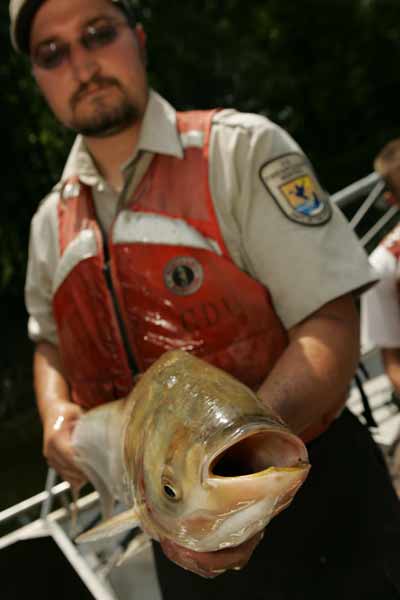
Photo courtesy of the National Park Service.
The Asian Carp is an invasive
New Maritime Insurance Case from Seventh Circuit – Egan Marine Corp. v. Great American Insur. Co.
New maritime insurance case from the Seventh Circuit Court of Appeals. The case involves a pollution insurance policy and coverage for an oil spill following a vessel explosion in Chicago. The case is Egan Marine Corp. v. Great American Insur. Co., 2011 U.S. App. LEXIS 23369 and the original opinion can be found here.
The
When is a floating structure not a vessel? The City of Riviera Beach vs That Certain Unnamed Gray, Two-Story Vessel Approximately Fifty-Seven Feet in Length, Fane Lozman
You know you have a backlog of cases to post when you see a cert petition appealing the un-blogged case….
So, to rectify that delay, let’s talk about what is a “vessel” – or if it walks like a duck, talks like a duck, but can’t swim like a duck ….
Before we start –
Supreme Court’s Busy Ocean (Kinda) Law Docket
I just saw the Petitions to Watch on SCOTUSBLOG.
Two cases of relevance to this blog (in my humble opinion anyway):
For the Con Law wonks: Sun v. United States. This case arises from the federal district court in the Commonwealth of Northern Mariana Islands. A criminal defendant challenged his criminal conviction on the basis that the trial judge was not an Article III judge, ergo the judge did not have jurisdiction to hear the case. The Ninth Circuit summarily affirmed the conviction, finding that the judge was an Article IV judge.
For the International Law wonks: Bowoto v. Chevron. The petition asks the court whether American companies can be liable under the Torture Victim Protection Act, 28 U.S.C. 1350 which provides:
An individual who, under actual or apparent authority, or color of law, of any foreign nation— (1) subjects an individual to torture shall, in a civil action, be liable for damages to that individual; or (2) subjects an individual to extrajudicial killing shall, in a civil action, be liable for damages to the individual’s legal representative, or to any person who may be a claimant in an action for wrongful death.
No surprise in this petition because the Ninth Circuit acknowledged the split of interpretation of the Death on the High Seas Act, see my earlier post here. Stay tuned.
Eleventh Circuit Upholds Semi-Submersible Drug Running Statute
Cocaine smugglers have taken to use semi-submersible vessels attempting to avoid detection. The below photo is from a recent interdiction.
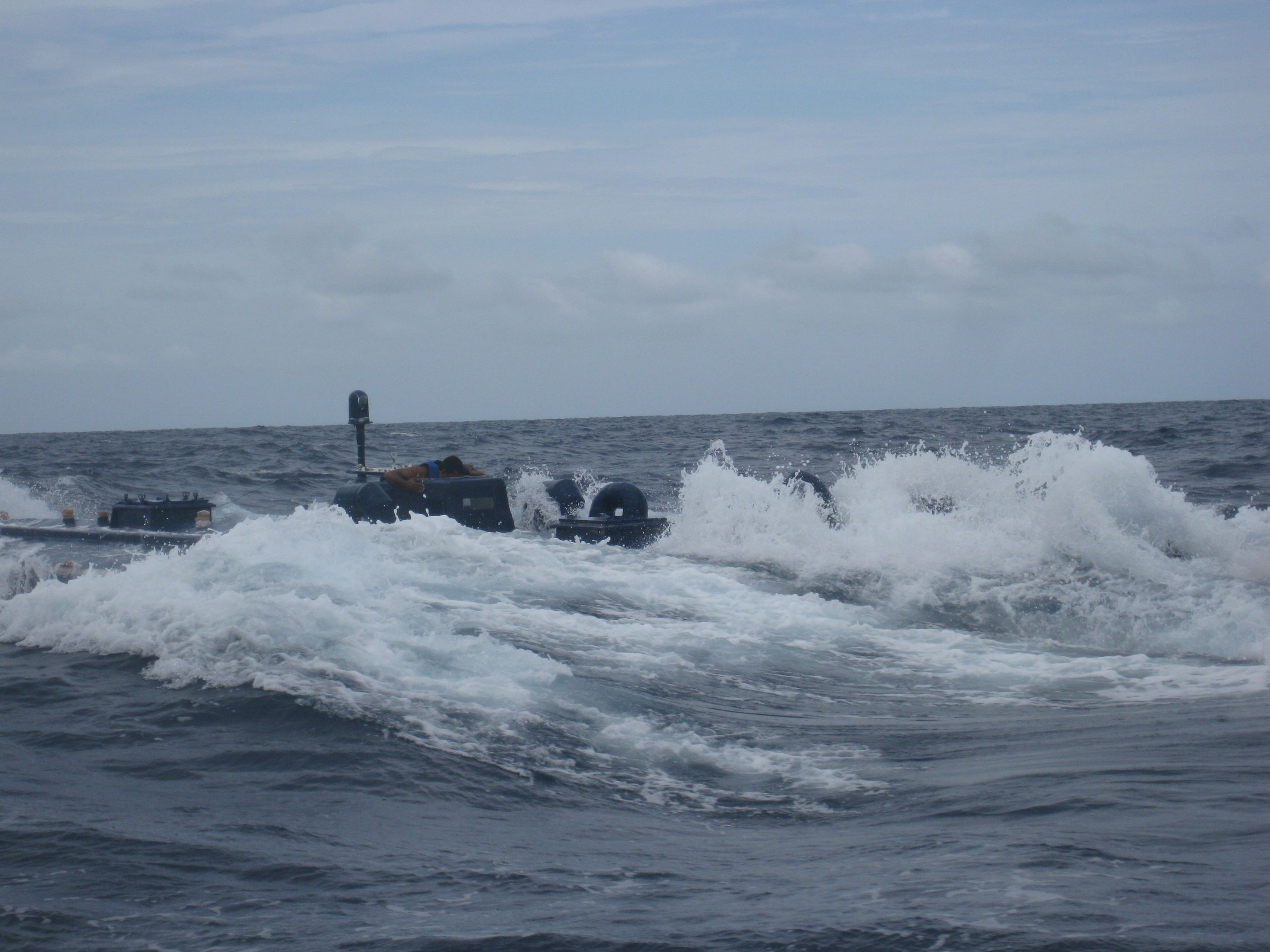
U.S. Coast Guard photo.
New criminal case from the Eleventh Circuit Court of Appeals involving the constitutionality of the semi-submersible drug trafficking statute, 18 U.S.C. 2285. The case is United States v. Campaz-Guerrero.
New Maritime Arbitration Case From Eleventh Circuit – Doe v. Princess Cruise Lines, Ltd.
New maritime arbitration case from the Eleventh Circuit Court of Appeals. It arises from a sexual assault perpetrated by a cruise ship employee upon another employee. The victim brought suit against the cruise line asserting various maritime employment causes of action (Jones Act, maintenance and cure, etc.) The employer sought to compel arbitration of her complaint per her employment agreement. The
New Ninth Circuit Opinion in the Hawaii – Guam Cabotage Case
The Filed Rate Doctrine.
Roughly speaking, the Filed Rate Doctrine is a bar to any antitrust lawsuit challenging rates for services that have been approved by a federal agency. In the case of maritime cargo trade, carriers must submit their rates to the Surface Transportation Board.
Spanish Treasure Hunter? Not so Fast Says 11th Circuit
In a case ripped from the tales of yore or the latest installment of Pirates of the Caribbean, the Eleventh Circuit Court of Appeals found that the U.S. courts had no in rem jurisdiction over a sunken Spanish ship. The case is Odyssey Marine Exploration v. The Unidentified Shipwrecked Vessel, Its Apparel, Tackle, Appurtenances &