
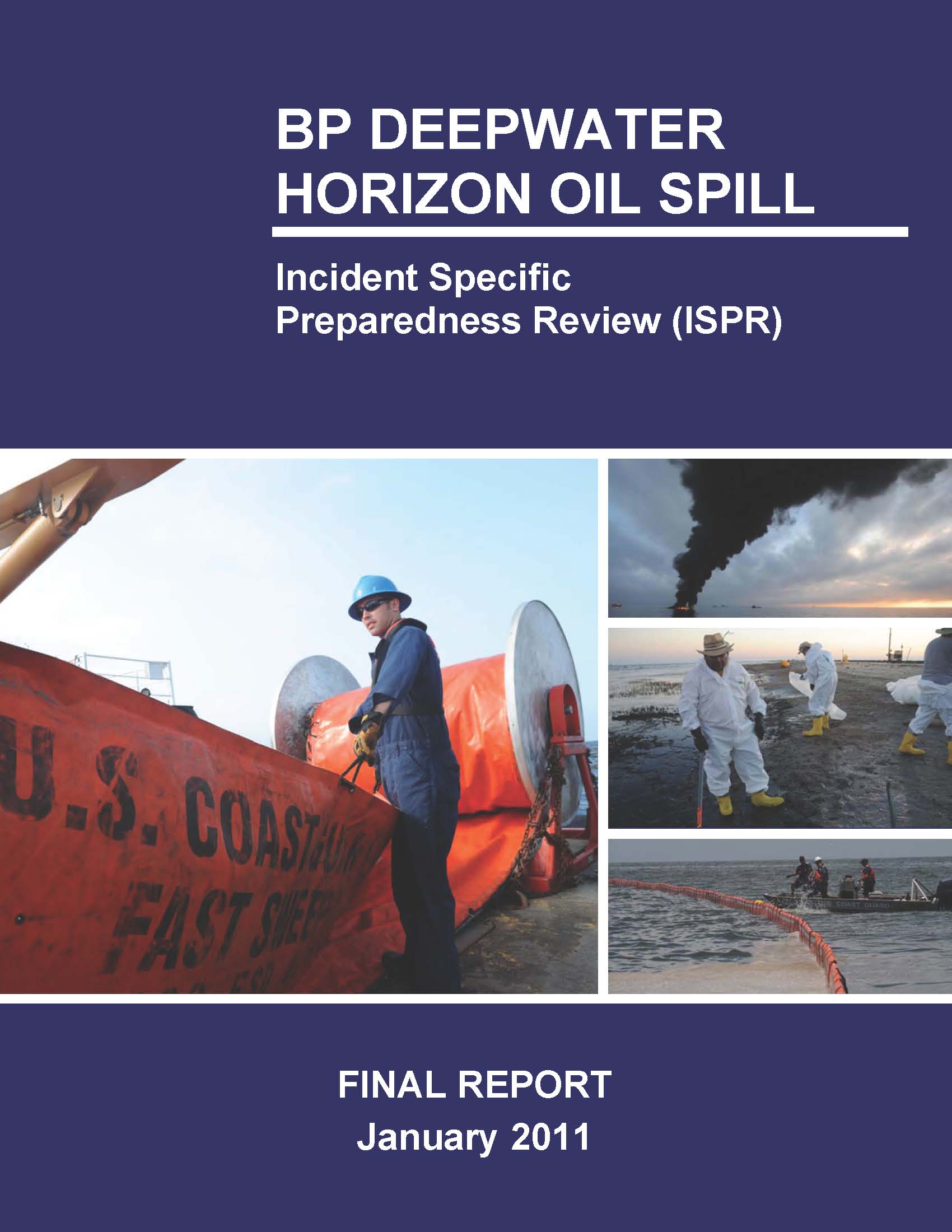
The U.S. Coast Guard has released its “Incident Specific Preparedness Review” for the Deepwater Horizon oil spill of 2010.  Fox is reporting that this report suggests the Administration slowed some of the flow of information from the responders.
BPDWH 4 

The Commandant of the Coast Guard’s approval memorandum states:

On February I, 20II, I received the

The Coast Guard published a Programmatice Environmental Assessment for the Nationwide Use of High Frequency and Ultra High Frequency SONAR.  The publication notice is here.  Comments can be posted at www.regulations.gov.  The Environmental Assessment is here.  The State of Hawaii is conducting a consistency determination per the Coastal Zone Management Act, see

Found an interesting case recently relating to Fairbanks Morse diesel engines on several Navy ships.  The United States, particularly the Environmental Protection Agency, brought suit against Coltec Industries for violations of the Clean Air Act.  The complaint can be downloaded  here – US v. Coltec Industries, et al .

The government alleges that pursuant to the Clean

Yesterday, I posted about the Supreme Court taking a FOIA case from the Ninth Circuit, here. I have received the Petition for Certiorari from counsel and it is available here.

Mr. Milner requested an EQSD map for the Naval Magazine at Indian Island.  The EQSD is a map which shows the blast radius for explosives and shows how far an explosion will “expand” should one of the munitions detonate.

At issue is an exemption from the Freedom of Information Act which protects from disclosure documents relating to internal personnel rules and practices of an agency.

5 U.S.C. § 552(b) of the Freedom of Information Act (“Exemption 2”) provides in pertinent part:

(b) This section [providing for public access to government documents] does not apply to matters that are:

(2) related solely to the internal personnel rules and practices of an agency.

Courts have created two categories of documents using this exemption:  “High 2” and “Low 2”.  The Supreme Court upheld the use of this exemption for documents that were trivial in nature.  Dep’t of the Air Force v. Rose, 425 U.S. 352 (1976).  The Ninth Circuit (and other courts of appeal) have created a “High 2” exemption for FOIA that allows documents that could circumvent an “agency regulation” to be withheld.

This petition seeks to undo the High 2 exemption from FOIA. 

This will be very interesting in terms of the balance between national security and transparent democratic government.  We shall also see the balancing of a textual approach to statutory interpretation and national security interests of the nation.

News Flash – the Supreme Court is going to review a Ninth Circuit FOIA case relating to the Naval Magazine at Indian Island in Puget Sound.  FOIA cases at the Supreme Court are few and far between, so this is pretty big (for us FOIA wonks anyway).  My post on the Ninth Circuit's decision here.

The Question Presented is:

Whether 5 U.S.C. § 552(b)(2), which allows a government agency to keep secret only documents related solely to the internal personnel rules and practices of an agency, must be strictly construed to preclude the "High 2" expansion created by some circuits but rejected by others.

Briefly summarizing the Ninth Circuit decision:

The Plaintiff submitted a FOIA request for government records relating to the Naval Magazine at Indian Island in Puget Sound.  The Navy disclosed about 1000 pages of records but did not release 81 documents, citing to two exemptions of the Freedom of Information Act.

Plaintiff brought suit and the Navy obtained summary judgment from the trial court.  The Ninth Circuit affirmed the decision finding that the the records were exempt under the FOIA's Exemption 2 (exempting from disclosure matters that are “related solely to the internal personnel rules and practices of an agency.”)

This exemption protects records which could be used to circumvent government regulations or those sensitive records designed for the agency's own internal use (assuming that they are particularly sensitive).

The Navy refused to turn over maps which denoted the blast radius around the Island based on the various types of munitions stored there.  The Court found that to disclose the records posed a risk that the records would be used to circumvent the law.  Therefore, the records were not required to be disclosed under FOIA.

I have asked plaintiff's counsel for a copy of the Petition for Certiorari and will post if received.  The government's brief in opposition is here.  The government's question presented was a little different:

Whether Exemption 2 of the Freedom of Information Act, 5 U.S.C. 552(b)(2), exempts from disclosure technical explosive and ammunition safety maps used by Navy personnel for the safe handling and storage of ordnance at Naval Magazine Indian Island.

This is an interesting case that has been comprehensively covered by my partner, Robert Thomas, on his blog, www.inversecondemnation.com.  But, it is an important shoreline precedent and deserves mention here.

Simply put, can a shoreline property owner be liable, under the Rivers and Harbors Appropriation Act of 1899, 33 U.S.C. s. 401, when structures that were lawful when constructed become unlawful (in trespass) through a property boundary that shifted shoreward through erosion? The Ninth Circuit opinion which answered that question, YES, is here.  The case is Sharp v. United States and this petition for Supreme Court review is certainly one to watch.

By way of factual background, aWashington shorefront property owner had erected a “shoreline defense structure” on then-dry land.  The land near the structure eroded and the structure then jutted out into now-tidelands.  Those tidelands were owned by the Lummi Indian Nation who, joined by the federal government, sued the property owner for trespass.

This case is the logical follow-on to another Rivers and Harbors case, United States v. Alameda Gateway, Ltd. 213 F.3d 1161 (2000)[Note: Robert rep’d landowner in that case].  In that case, the Ninth Circuit held:

Although § 10 does not explicitly mention the maintenance of structures in navigable waters, in the sense of keeping structures in place, we have interpreted the RHA as making unlawful the failure to remove structures prohibited by § 10, even if they were previously legal.

The problem with Alameda Gateway is that the statute prohibits the “creation of any obstruction” and “build or commence the building of any …bulkhead, jetty or other structure.”  44 U.S.C. s. 403.  The statute doesn’t say anything about failing to remove structures.

Lots here.  Still digesting, stay tuned for more posts.


I am on the redeye to Los Angeles tonight, but wanted to get this news release posted.  Apparently, there has been some concerns about starting and finishing canoe regattas in the various harbors and the Coast Guard and State of Hawaii Department of Land and Natural Resources are crafting policy to address the issue.

The

The Advertiser ran a story this morning on a bill pending in the Legislature regarding the definition of the boundary between oceanfront landowners and the public.  Article here.

I pulled the bill and it is reprinted below:

RELATING TO COASTAL AREAS.

BE IT ENACTED BY THE LEGISLATURE OF THE STATE OF HAWAII:

SECTION 1. Section 205A-1, Hawaii Revised Statutes, is amended by amending the definition of “shoreline” to read as follows:

“Shoreline” means the upper reaches of the wash of the waves, other than storm and seismic waves, at high tide during the season of the year in which the highest wash of the waves occurs, usually evidenced by the edge of natural vegetation growth, or the upper limit of debris left by the wash of the waves[-], whichever is further most mauka, but never lower than the upper limit of debris left by the wash of the waves.”

SECTION 2. Statutory material to be repealed is bracketed and stricken. New statutory material is underscored.

SECTION 3. This Act shall take effect on July 1, 2050.

You can download here.  It is pretty sparse and appears to be a placeholder for further legislative action. 

Stay tuned.

Winter… Part Two.  A Florida newspaper is reporting an environmental challenge to the Navy's training area off the east coast of Florida. 

Per the article,

A dozen environmental groups filed suit today to stop a U.S. Navy plan to build its $100 million Undersea Warfare Training Range about 50 miles east of Jacksonville, near known calving grounds for the endangered North Atlantic right whale.

The legal challenge alleges that the Navy and the National Marine Fisheries Service failed to study the impacts that building and operating the range would have on right whales.

They fear the sonar used at the range could damage to the giant mammals’ ability to navigate, increasing the risk of beaching and death as they migrate and calve along Florida’s east coast — including the Space Coast — primarily in January and February.

An association long line fishermen has filed suit in federal court in Hawaii against the National Marine Fisheries Service, alleging the agency has not authorized the incidental taking of humpback whales in Hawaiian waters.

The Complaint (filed Jan. 22, 2010) is posted here.here. The Complaint summarizes the lawsuit:

1. This civil action is