
Taking a page from my partner and fellow blogger, Robert Thomas, I thought it would be interesting to see what Supreme Court nominee Sonia Sotomayor's record was at it relates to admiralty or maritime law. My search was hardly comprehensive and was strictly focused at the opinions she expressly authored (no per curiam opinions)
Hawaii Business Magazine Quote – Working to Balance
Hawaii Business magazine published a quote of mine on balancing work, home and families in their June 2009 issue (p.97). It is available here.
My quotes were:
On prioritizing: "My priorities, in order, are: husband, father, attorney, Coast Guard Reserve Officer."
On success: "Success at work means nothing if you are unsuccessful at home."
Venezuela Seizes Boat Fleet – Actionable Claims in U.S. Courts?
A former shipmate of mine asked me for my thoughts on the recourse an American company would have after a fleet of its boats were seized by a foreign government. Per this Marinelog.com post, Venezuela has apparently seized/nationalized an American company’s vessel fleet in Lake Maracaibo.

My shipmate’s question is a very complicated one worthy of several books, cases and law reviews (many exist), but in the interest of brevity and overview, here goes:
The “nationalization” or expropriation of assets is not a new happening on the world stage. From a legal perspective, a country’s seizure of property within its borders was not viewed upon as actionable under U.S. law. See Banco Nacional de Cuba v. Sabatino, 376 U.S. 298 (1964)(adopting the act of state doctrine to exempt such seizures from review in U.S. courts).
In the wake of the Cuba expropriations and the Supreme Court’s Banco decision, Congress adopted federal law that superceded the decision. This law, 22. U.S.C. 2370 provides:
(e) Nationalization, expropriation or seizure of property of United States citizens, or taxation or other exaction having same effect; failure to compensate or to provide relief from taxes, exactions, or conditions; report on full value of property by Foreign Claims Settlement Commission; act of state doctrine.
(1) The President shall suspend assistance to the government of any country to which assistance is provided under this or any other Act when the government of such country or any government agency or subdivision within such country on or after January 1, 1962–
(A) has nationalized or expropriated or seized ownership or control of property owned by any United States citizen or by any corporation, partnership or association not less than 50 per centum beneficially owned by United States citizens, or
(B) has taken steps to repudiate or nullify existing contracts or agreements with any United States citizen or any corporation, partnership, or association not less than 50 per centum beneficially owned by United States citizens, or
(C) has imposed or enforced discriminatory taxes or other exactions, or restrictive maintenance or operational conditions, or has taken other actions, which have the effect of nationalizing, expropriating, or otherwise seizing ownership or control of property so owned, and such country, government agency, or government subdivision fails within a reasonable time (not more than six months after such action, or, in the event of a referral to the Foreign Claims Settlement Commission of the United States within such period as provided herein, not more than twenty days after the report of the Commission is received) to take appropriate steps, which may include arbitration, to discharge its obligations under international law toward such citizen or entity, including speedy compensation for such property in convertible foreign exchange, equivalent to the full value thereof, as required by international law, or fails to take steps designed to provide relief from such taxes, exactions, or conditions, as the case may be; and such suspension shall continue until the President is satisfied that appropriate steps are being taken, and the provisions of this subsection shall not be waived with respect to any country unless the President determines and certifies that such a waiver is important to the national interests of the United States. Such certification shall be reported immediately to Congress.
Upon request of the President (within seventy days after such action referred to in subparagraphs (A), (B), or (C) of paragraph (1)), the Foreign Claims Settlement Commission of the United States (established pursuant to Reorganization Plan No. 1 of 1954, 68 Stat. 1279 note]) is hereby authorized to evaluate expropriated property, determining the full value of any property nationalized, expropriated, or seized, or subjected to discriminatory or other actions as aforesaid, for purposes of this subsection and to render an advisory report to the President within ninety days after such request. Unless authorized by the President, the Commission shall not publish its advisory report except to the citizen or entity owning such property. There is hereby authorized to be appropriated such amount, to remain available until expended, as may be necessary from time to time to enable the Commission to carry out expeditiously its functions under this subsection.
(2) Notwithstanding any other provision of law, no court in the United States shall decline on the ground of the federal act of state doctrine to make a determination on the merits giving effect to the principles of international law in a case in which a claim of title or other right to property is asserted by any party including a foreign state (or a party claiming through such state) based upon (or traced through) a confiscation or other taking after January 1, 1959, by an act of that state in violation of the principles of international law, including the principles of compensation and the other standards set out in this subsection: Provided, That this subparagraph shall not be applicable (1) in any case in which an act of a foreign state is not contrary to international law or with respect to a claim of title or other right to property acquired pursuant to an irrevocable letter of credit of not more than 180 days duration issued in good faith prior to the time of the confiscation or other taking, or (2) in any case with respect to which the President determines that application of the act of state doctrine is required in that particular case by the foreign policy interests of the United States and a suggestion to this effect is filed on his behalf in that case with the court.The seizure may implicate U.S. law and give rise to claims against Venezuela if the expropriation was done in violation of international law. United Nations General Assembly Resolution 1803 may provide such violation if the seizure was done without compensation. If the owner is compensated, then it may not have recourse.
One mechanism used for other cases of expropriation is the Foreign Claims Settlement Commission. It appears that most of its cases are not run-of-the-mill claims but post-war, post-terrorist incident type matters.
Interesting issue to watch in these uncertain economic times.
Right Service to Combat Piracy – Coast Guard or Navy…How About Both?
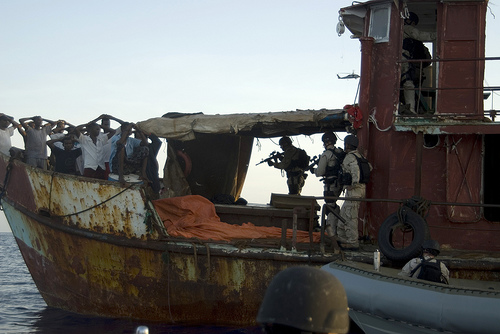
Last week, I posted an Op-Ed from Newsweek asserting that the Coast Guard was the better service to address Somali piracy (post here). The “war” on drugs has required the use of Coast Guard Law Enforcement Detachments (LEDETs) embarked on Navy ships (typically, less capable frigates) to extend the reach of U.S. law enforcement without requiring the nation to build more Coast Guard cutters. The model works well and has been employed in the Persian Gulf since the first Gulf War. In fact, the first Coast Guardsman killed in combat since Vietnam, Petty Officer Nathan Bruckenthal, lost his life with two sailors while intervening in a suicide bomb attack on an Iraqi oil platform in 2004.
Per the Navy’s post on flickr.com:
GULF OF ADEN (May 13, 2009) Members of a visit, board, search and seizure (VBSS) team from the guided-missile cruiser USS Gettysburg (CG 64) and U.S. Coast Tactical Law Enforcement Team South Detachment 409 capture suspected pirates after responding to a merchant vessel distress signal while operating in the Combined Maritime Forces (CMF) area of responsibility as part of Combined Task Force (CTF) 151. CTF 151 is a multinational task force established to conduct counter-piracy operations under a mission-based mandate throughout the CMF area of responsibility to actively deter, disrupt and suppress piracy in order to protect global maritime security and secure freedom of navigation for the benefit of all nations. (U.S. Navy photo by Mass Communication Specialist 1st Class Eric L. Beauregard/Released)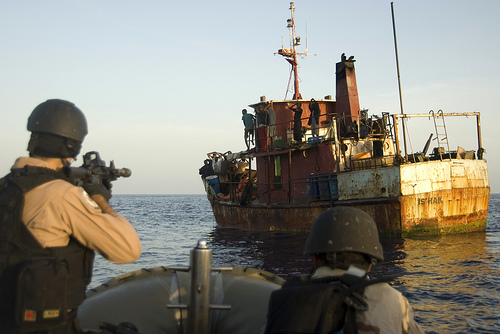
Obama’s National Security Council and the 21st Century Interagency
National Security Adviser James Jones has distributed guidance on the National Security Council's processes in a memorandum entitled, "The 21st Century Interagency Process." It can be downloaded here (hat tip to foreignpolicy.com).
As we all know, the 21st Century announces itself as one in which there are great challenges to the symmetric world of the
Update on Suit Against Coast Guard to Protect Blue Whales: Court Lacks Jurisdiction
Last year, the environmental group, Center for Biological Diversity (Center), brought suit against the U.S. Coast Guard for violations of the Endangered Species Act (ESA) relating to the execution of Coast Guard missions off the coast of California, (post here). Specifically, at issue were the Coast Guard’s Traffic Separation Schemes (TSS) which are, in effect, shipping lanes used to separate inbound and outbound vessels. The three TSS’s that were before the court were the Santa Barbara, Long Beach and San Francisco ones. The Centerasserted that the Coast Guard failed to consult with the National Marine Fisheries Service to determine the impact of TSS’s on endangered blue whales.
The federal court in San Francisco dismissed the suit finding that the claimed ESA violations relating to the Long Beach and San Francisco TSS’s lacked jurisdiction for failing to fulfill the ESA’s procedural requirement of providing specific notice of an intention to bring suit. The Center’s notice letter only discussed the Santa Barbara TSS.
As to the Santa Barbara TSS, the court found that the challenged action by the Coast Guard was not “ongoing,” thereby finding the Center’s claims to be stale or time-barred by the statute of limitation. The court further found that any Coast Guard operations related to the TSS (radio advisories, maintenance of aids to navigation) do not constitute “agency action” triggering a right to court review.
The court did give the Center a hint as to Round 2. In footnote 3, the court stated:
The absence of ongoing or new agency action, however, does not suggest a party such as plaintiff has no legal recourse where circumstances affecting listed species assertedly have changed. Rather, the law provides an appropriate vehicle for seeking such relief. In particular, a petition for new rulemaking may be filed, see 5 U.S.C. § 553(e), and, if the petition is denied, judicial review of such denial may be sought, see 5 U.S.C. § 704. Additionally, to the extent private parties are asserted to be in violation of the ESA by “tak[ing]” listed species, suit may be brought against such parties under § 9 of the ESA, 16 U.S.C. § 1538. Here, plaintiff filed a Petition for Emergency Rulemaking with NMFS (see Cummings Decl. Ex. A), which petition was denied (see id. Ex. D). There is no evidence in the record, however, suggesting plaintiff sought judicial review of such denial.
I have obtained copies of the pleadings which are available for download below:
Coast Guard’s Motion for Summary JudgmentCenter’s Memorandum in OppositionCoast Guard’s ReplyOrder Granting Motion for Summary JudgmentFinal Judgment
How Far do Counties Go Into Ocean Waters? New Hawaii case
Newsweek Article – More Opinions On Somali Piracy – Coast Guard vs. Navy
Found this interesting article in Newsweek which suggests that the U.S. Coast Guard and not the Navy is better suited to address the Somali piracy situation.
The counterpiracy plan outlined Wednesday by Secretary of State Hillary Clinton was short on specifics, but long on nuance. Clinton committed to tracking and freezing the Somali bandits' finances—something that could prove difficult—while also working with shipping conglomerates and insurance companies to address "gaps in their self-defense measures." With a heavy military presence in the region all but off the table, given officials' remarks on the subject, what could that mean?
John Patch, a retired Navy commander who now teaches at the U.S. Army War College, has one possible answer. In the past few months, Patch has repeatedly said the global security threat posed by pirates is "overstated." But if Washington now feels compelled to respond to the surge in piracy in the Gulf of Aden, Patch argues, the best approach would be to treat the problem as a law-enforcement issue, not a military mission. NEWSWEEK's Katie Paul spoke to him about why, if the U.S. is to play any armed role in responding to the Somali pirates, the Coast Guard might be its best bet.
While the Coast Guard is likely the best maritime military force worldwide to address Somali piracy, bar none, it is plainly too small to take on another mission. Law Enforcement Detachment (LEDETs) embarked on Navy or other allied ships could provide a crucial, internationally viable response to the pirate threat. Endgame remains a vexing issue and absent political will for prosecution/incarceration in other countries, the Gulf of Aden's cat and mouse game will continue.
New Admiralty Case – In Rem Defendants Covered by Himalaya Clause
The Court of Appeals for the Ninth Circuit just issued its opinion in the case of Mazda Motors of America, Inc. v. M/V Cougar Ace (opinion here).
The legal issue is whether a defendant in rem can assert a contract right despite being a non-party to the contract. The clause in question was a forum selection clause.
This case arises out of the M/V Cougar Ace mishap (depicted here)
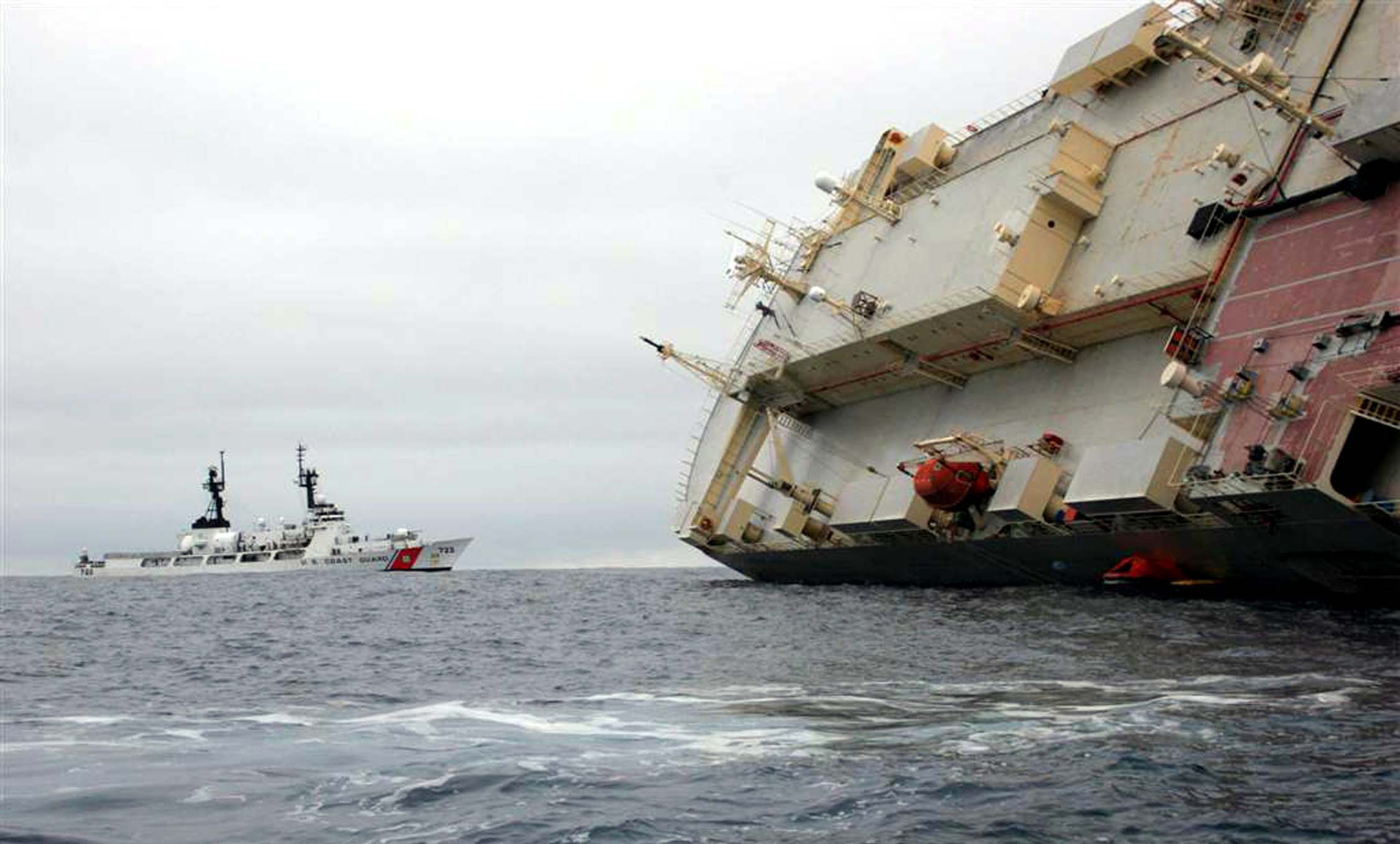
The bills of lading for the cargo had a forum selection clause requiring that disputes be resolved in Tokyo, Japan. The ship itself was not a party to the bills of lading, but was named as a defendant in a proceeding brought in Portland, Oregon. The bills of lading had a Himalaya clause which provided:
The Merchant undertakes that no claim or allegation shall be made against any servant, agent or Sub- Contractor of the Carrier which imposes or attempts to impose upon any of them, or upon any vessel owned or operated by any of them, any liability whatsoever in connection with the Goods, and, if any such claim or allegation should nevertheless be made, to indemnify the Carrier against all consequences thereof. Without prejudice to the foregoing, every such servant, agent and Sub-Contractor shall have the benefit of all provisions herein benefiting
the Carrier as if such provisions were expressly for their benefit; and in entering into this contract, the Carrier, to the extent of those provisions, does so not only on its own behalf, but also as agent and trustee for such servants, agents and Sub-Contractors.The Himalaya clause contractually allows non-parties to assert rights under the contract. The Ninth Circuit’s opinion seemed compelled by the Supreme Court’s 2004 decision in the Norfolk Southern Railway Co. v. Kirby decision. The unanimous decision required an expansive view of Himalaya clauses (which theretofore had been construed narrowly). Justice O’Connor stated:
The Court of Appeals’ ruling is not true to the contract language or to the intent of the parties. The plain language of the Himalaya Clause indicates an intent to extend the liability limitation broadly — to “any servant, agent or other person (including any independent contractor)” whose services contribute to performing the contract. App. to Pet. for Cert. 59a, cl. 10.1 (emphasis added). “Read naturally, the word `any’ has an expansive meaning, that is, `one or some indiscriminately of whatever kind.'” United States v. Gonzales, 520 U. S. 1, 5 (1997) (quoting Webster’s Third New International Dictionary 97 (1976)). There is no reason to contravene the clause’s obvious meaning. See Green v. Biddle, 8 Wheat. 1, 89-90 (1823) (“[W]here the words of a law, treaty, or contract, have a plain and obvious meaning, all construction, in hostility with such meaning, is excluded”). The expansive contract language corresponds to the fact that various modes of transportation would be involved in performing the contract. Kirby and ICC contracted for the transportation of machinery from Australia to Huntsville, Alabama, and, as the crow flies, Huntsville is some 366 miles inland from the port of discharge. See G. Fitzpatrick & M. Modlin, Direct-Line Distances 168 (1986). Thus, the parties must have anticipated that a land carrier’s services would be necessary for the contract’s performance. It is clear to us that a railroad like Norfolk was an intended beneficiary of the ICC bill’s broadly written Himalaya Clause. Accordingly, Norfolk’s liability is limited by the terms of that clause.
Apparently, there had never been a reported decision of an in rem defendant being protected by the Himalaya clause…till today.
NTSB Releases Cosco Busan Report – Coast Guard VTS Criticized
The National Transportation Safety Board has released its report on the Cosco Busan incident (quick and dirty summary in the San Francisco Chronicle’s article here).

From the Executive Summary:
The National Transportation Safety Board determines that the probable cause of the
allision of the Cosco Busan with the San Francisco–Oakland Bay Bridge was the failure to safely
navigate the vessel in restricted visibility as a result of (1) the pilot’s degraded cognitive
performance from his use of impairing prescription medications, (2) the absence of a
comprehensive pre-departure master/pilot exchange and a lack of effective communication
between the pilot and the master during the accident voyage, and (3) the master’s ineffective
oversight of the pilot’s performance and the vessel’s progress. Contributing to the accident was the failure of Fleet Management Ltd. to adequately train the Cosco Busan crewmembers before their initial voyage on the vessel, which included a failure to ensure that the crew understood and complied with the company’s safety management system. Also contributing to the accident was the U.S. Coast Guard’s failure to provide adequate medical oversight of the pilot in view of the medical and medication information that the pilot had reported to the Coast Guard.The following safety issues were identified during this accident investigation:
• Medical oversight of the Cosco Busan pilot;
• Medical oversight of mariners in general;
• Guidance for vessel traffic service operators in exercising authority to manage traffic;
• Procedures for improving the assessment of oil spills in California waters; and
• Training and oversight of the Cosco Busan crew.Board member Deborah A.P. Hersman issued her own statement in dissent, identifying her criticism of the Coast Guard’s Vessel Traffic Service (VTS):
The taxpayers support 35 employees at VTS San Francisco to provide this protection and enforce discipline in an industry of safe professionals who may be imprudently influenced by economic pressures and who may occasionally make mistakes. VTS San Francisco’s stated purpose is to facilitate the safe and efficient transit of vessel traffic in an effort to prevent collisions, rammings, groundings, and the associated loss of life and damage to property and the environment. By not naming VTS as a contributing factor in the probable cause, the Board turned a blind eye to the public’s strongest safety advocate in the San Francisco Bay.