
Newsweek Article – More Opinions On Somali Piracy – Coast Guard vs. Navy
Found this interesting article in Newsweek which suggests that the U.S. Coast Guard and not the Navy is better suited to address the Somali piracy situation.
The counterpiracy plan outlined Wednesday by Secretary of State Hillary Clinton was short on specifics, but long on nuance. Clinton committed to tracking and freezing the Somali bandits' finances—something that could prove difficult—while also working with shipping conglomerates and insurance companies to address "gaps in their self-defense measures." With a heavy military presence in the region all but off the table, given officials' remarks on the subject, what could that mean?
John Patch, a retired Navy commander who now teaches at the U.S. Army War College, has one possible answer. In the past few months, Patch has repeatedly said the global security threat posed by pirates is "overstated." But if Washington now feels compelled to respond to the surge in piracy in the Gulf of Aden, Patch argues, the best approach would be to treat the problem as a law-enforcement issue, not a military mission. NEWSWEEK's Katie Paul spoke to him about why, if the U.S. is to play any armed role in responding to the Somali pirates, the Coast Guard might be its best bet.
While the Coast Guard is likely the best maritime military force worldwide to address Somali piracy, bar none, it is plainly too small to take on another mission. Law Enforcement Detachment (LEDETs) embarked on Navy or other allied ships could provide a crucial, internationally viable response to the pirate threat. Endgame remains a vexing issue and absent political will for prosecution/incarceration in other countries, the Gulf of Aden's cat and mouse game will continue.
New Admiralty Case – In Rem Defendants Covered by Himalaya Clause
The Court of Appeals for the Ninth Circuit just issued its opinion in the case of Mazda Motors of America, Inc. v. M/V Cougar Ace (opinion here).
The legal issue is whether a defendant in rem can assert a contract right despite being a non-party to the contract. The clause in question was a forum selection clause.
This case arises out of the M/V Cougar Ace mishap (depicted here)
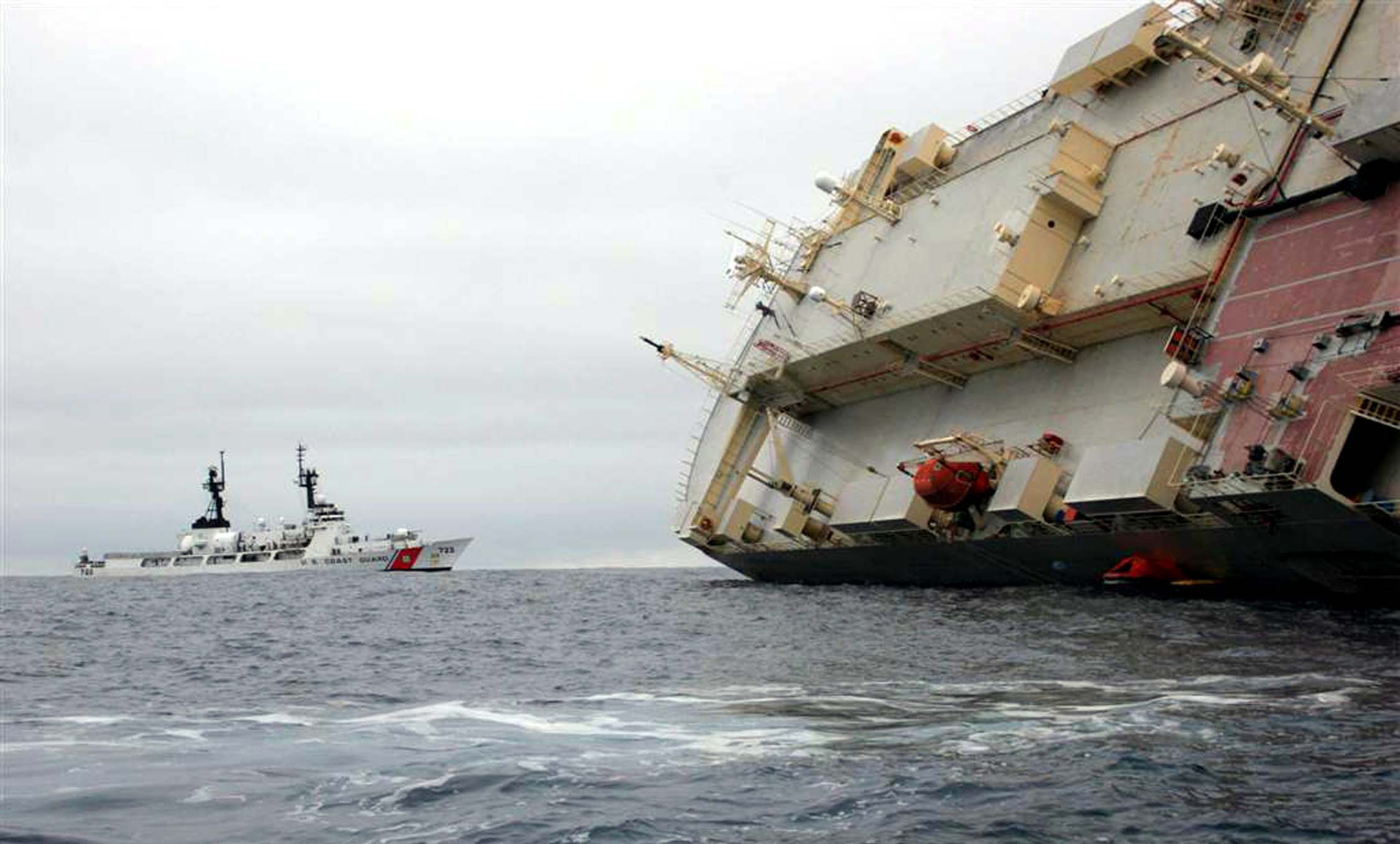
The bills of lading for the cargo had a forum selection clause requiring that disputes be resolved in Tokyo, Japan. The ship itself was not a party to the bills of lading, but was named as a defendant in a proceeding brought in Portland, Oregon. The bills of lading had a Himalaya clause which provided:
The Merchant undertakes that no claim or allegation shall be made against any servant, agent or Sub- Contractor of the Carrier which imposes or attempts to impose upon any of them, or upon any vessel owned or operated by any of them, any liability whatsoever in connection with the Goods, and, if any such claim or allegation should nevertheless be made, to indemnify the Carrier against all consequences thereof. Without prejudice to the foregoing, every such servant, agent and Sub-Contractor shall have the benefit of all provisions herein benefiting
the Carrier as if such provisions were expressly for their benefit; and in entering into this contract, the Carrier, to the extent of those provisions, does so not only on its own behalf, but also as agent and trustee for such servants, agents and Sub-Contractors.The Himalaya clause contractually allows non-parties to assert rights under the contract. The Ninth Circuit’s opinion seemed compelled by the Supreme Court’s 2004 decision in the Norfolk Southern Railway Co. v. Kirby decision. The unanimous decision required an expansive view of Himalaya clauses (which theretofore had been construed narrowly). Justice O’Connor stated:
The Court of Appeals’ ruling is not true to the contract language or to the intent of the parties. The plain language of the Himalaya Clause indicates an intent to extend the liability limitation broadly — to “any servant, agent or other person (including any independent contractor)” whose services contribute to performing the contract. App. to Pet. for Cert. 59a, cl. 10.1 (emphasis added). “Read naturally, the word `any’ has an expansive meaning, that is, `one or some indiscriminately of whatever kind.'” United States v. Gonzales, 520 U. S. 1, 5 (1997) (quoting Webster’s Third New International Dictionary 97 (1976)). There is no reason to contravene the clause’s obvious meaning. See Green v. Biddle, 8 Wheat. 1, 89-90 (1823) (“[W]here the words of a law, treaty, or contract, have a plain and obvious meaning, all construction, in hostility with such meaning, is excluded”). The expansive contract language corresponds to the fact that various modes of transportation would be involved in performing the contract. Kirby and ICC contracted for the transportation of machinery from Australia to Huntsville, Alabama, and, as the crow flies, Huntsville is some 366 miles inland from the port of discharge. See G. Fitzpatrick & M. Modlin, Direct-Line Distances 168 (1986). Thus, the parties must have anticipated that a land carrier’s services would be necessary for the contract’s performance. It is clear to us that a railroad like Norfolk was an intended beneficiary of the ICC bill’s broadly written Himalaya Clause. Accordingly, Norfolk’s liability is limited by the terms of that clause.
Apparently, there had never been a reported decision of an in rem defendant being protected by the Himalaya clause…till today.
NTSB Releases Cosco Busan Report – Coast Guard VTS Criticized
The National Transportation Safety Board has released its report on the Cosco Busan incident (quick and dirty summary in the San Francisco Chronicle’s article here).

From the Executive Summary:
The National Transportation Safety Board determines that the probable cause of the
allision of the Cosco Busan with the San Francisco–Oakland Bay Bridge was the failure to safely
navigate the vessel in restricted visibility as a result of (1) the pilot’s degraded cognitive
performance from his use of impairing prescription medications, (2) the absence of a
comprehensive pre-departure master/pilot exchange and a lack of effective communication
between the pilot and the master during the accident voyage, and (3) the master’s ineffective
oversight of the pilot’s performance and the vessel’s progress. Contributing to the accident was the failure of Fleet Management Ltd. to adequately train the Cosco Busan crewmembers before their initial voyage on the vessel, which included a failure to ensure that the crew understood and complied with the company’s safety management system. Also contributing to the accident was the U.S. Coast Guard’s failure to provide adequate medical oversight of the pilot in view of the medical and medication information that the pilot had reported to the Coast Guard.The following safety issues were identified during this accident investigation:
• Medical oversight of the Cosco Busan pilot;
• Medical oversight of mariners in general;
• Guidance for vessel traffic service operators in exercising authority to manage traffic;
• Procedures for improving the assessment of oil spills in California waters; and
• Training and oversight of the Cosco Busan crew.Board member Deborah A.P. Hersman issued her own statement in dissent, identifying her criticism of the Coast Guard’s Vessel Traffic Service (VTS):
The taxpayers support 35 employees at VTS San Francisco to provide this protection and enforce discipline in an industry of safe professionals who may be imprudently influenced by economic pressures and who may occasionally make mistakes. VTS San Francisco’s stated purpose is to facilitate the safe and efficient transit of vessel traffic in an effort to prevent collisions, rammings, groundings, and the associated loss of life and damage to property and the environment. By not naming VTS as a contributing factor in the probable cause, the Board turned a blind eye to the public’s strongest safety advocate in the San Francisco Bay.
Op-Ed on Somali Piracy and International Law
The Pacific Business News published an Op-Ed I drafted on International Law and Somali Piracy. (PBN has published here).
My text is repeated below:
Until recently, we viewed “piracy” to be teenagers downloading internet songs or copying a DVD. Now, armed hijackings, crews and cargos held hostage in the Gulf of Aden
Maersk Alabama Mariner Sues for Pirate Attack
A Maersk Alabama mariner, Richard Hicks, has brought suit against Maersk for negligence, maintenance and cure and other damages allegedly suffered during the piratical attacks off Somalia recently.
The suit was brought in Houston, Texas. Thanks to gCaptain for the tip and Terry Bryant for posting the complaint online.
Complaint available here.
Coast Guard Report on Hawaii Catamaran Demasting Incidents
The Coast Guard has released its two marine casualty investigations into the facts and circumstances surrounding two separate de-masting incidents on Hawaii-based catamarans, Fourteenth Coast Guard District’s news release here.
More to follow after I digest the findings.
State of Hawaii Presentation on Natural Resource Damage Assessments
The Hawaii State Bar Association’s Admiralty Section was pleased to host two speakers from the State of Hawaii’s Department of Land and Natural Resources, Kamaile Nichols and Bin Li.
They discussed civil penalties or assessments for natural resource damages for injury to coral reefs. The pertinent legal authorities are set forth in a handout here
Somali Pirate – Criminal Complaint Outlines Charges
The criminal complaint outlining the charges against Somali pirate, Abduwali Abdukhadir Muse is available here. Based on the charges, he faces life imprisonment.
The four charges he faces are:
1. Piracy, 18 U.S.C. 1651, related to the seizure and robbery of the Maersk Alabama.
2. Violence against maritime navigation, 18 U.S.C. 2280(e), which criminalizes acts which, among other things, destroys or seriously damages maritime navigational facilities or seriously interferes with their operation, if such act is likely to endanger the safe navigation of a ship.
3. Use and carriage of a firearm in the commission of a crime of violence (specifically, violence against maritime navigation), 18 U.S.C. 924. This carries a mandatory minimum sentence of 10 years if the firearm is discharged.
4. Hostage taking, 18 U.S.C. 1203.
5. Use of a firearm during the hostage taking in violation of 18 U.S.C. 924.
Because piratical acts in U.S. waters are unheard of, this case will be the first piracy prosecution in a long time. I would be cautious about saying that it is the first piracy case in 100 years because the crime could have been charged as murder or robbery or the crime may have not been reported on or decided in a published opinion.
The exercise of criminal jurisdiction over extraterritorial crimes is not unprecedented. As the complaint notes, the United States successfully asserted jurisdiction over Ramzi Yousef, Osama Bin Laden (tried in absentia) and Shi Lei. The Ninth Circuit decision in Shi Lei is the only reported case interpreting the Violence Against Maritime Navigation statute. [Disclosure: while serving as a Coast Guard JAG, I was a Special Assistant U.S. Attorney and worked on the Shi Lei case].
Per the Ninth Circuit in Shi Lei:
Article I, Section 8, Clause 10 of the United States Constitution (the “Offense Clause”) empowers Congress to “define and punish Piracies and Felonies committed on the high Seas, and Offenses against the Law of Nations.” Because the high seas, by definition, lie outside United States territory, see United States v. Davis, 905 F.2d 245, 248 (9th Cir. 1990), the Offense Clause grants Congress the authority to apply federal law beyond the borders of the United States, see EEOC v. Arabian Am. Oil Co., 499 U.S. 244, 248 (1991).
Section 2280 is an exercise of Congress’s constitutional authority to define and punish “Felonies on the high Seas” because it proscribes felony offenses and expressly applies to international waters. See 18 U.S.C. § 2280(e). In addition, § 2280(a)(1)(A) and (B), the provisions under which Shi was charged, proscribe offenses which meet the definition of piracy. “Piracy” traditionally has been defined as “robbery, or forcible depredations upon the sea.” United States v. Smith, 18 U.S. 153, 161 (1820). “Depredation” is “the act of plundering, robbing, or pillaging.” Black’s Law Dictionary 397 (5th ed. 1979).
All three acts require the use of force.3 Section 2280(a)(1)(A) prohibits “seiz[ing] or exercis[ing] control over a ship by force or threat thereof,” and § 2280(a)(1)(B) prohibits “act[s] of violence against a person on board a ship” that are “likely to endanger the safe navigation of that ship.” Because such offenses involve interference with property on the open sea through the use of force, they are within Congress’s power to define and to punish crimes of piracy. See Smith, 18 U.S. at 158-59 (treating “Piracies,” “Felonies on the high Seas,” and “Offenses against the Laws of Nations” as three separate offenses).
My earlier posts on Somali piracy are: here, here, here, here, here, here. This list is getting long, I’ll put together a resource page later.
History of Piracy – Speech by Professor Andrew Jameson
I was fortunate to attend a lecture by Professor Andrew Jameson at Honolulu's Pacific Club on April 22.
Professor Jameson is a renowned expert on Near Asia. With a Harvard PhD, he was a longtime professor at the University of California-Berkeley and has consulted throughout the world.
He traced the history of piracy from its